
WhatsApp Purchase Optimization: Meta's Guide Explained, and What It Doesn't Tell You

Purchase optimization makes Click-to-WhatsApp ads pursue buyers, not just respondents. To unlock it, you must authorize event sharing, send over ten purchase events within seven days of a click within a 30-day window, and use labels recognized by Meta. API users depend on how their partner sends events via the Conversions API.
- The purchase goal changes the campaign target: the algorithm learns from the conversation outcome, not its start.
- Eligibility requires more than ten labeled purchase events within seven days of the click, within a 30-day period.
- Labels must use names recognized by the system: New order, Pending payment, Paid, and Completed order.
- Only orders marked as paid and completed count as actions for the performance goal.
- In the official API, the event is sent via the Conversions API, and the signaling method varies by partner, without Meta's control.
- The purchase event must originate within the WhatsApp conversation; external checkouts generate a weaker signal.
Meta has published an optimization guide for sales on WhatsApp and, in the middle of material that seems introductory, included the most relevant change of recent months for those advertising in Brazil: you can now ask the algorithm to look for those who buy, not those who respond.
It seems like a detail. It isn't. For years, Click-to-WhatsApp campaigns could only pursue two targets: link clicks and conversations started. Both are entry-level metrics. A lead who sends "hi" and disappears counts the same as a customer who closes an eight-thousand-real order. All optimization was done with this blindness.
Purchase optimization changes the target. And, like almost everything in the Meta ecosystem, it comes with a list of requirements that most companies do not meet today.
I have done a full reading of the guide. Below is what it says, what it asks for, where it contradicts itself, and what I would do with it in hand. The original file is available for download at the end of the article.
The target shift: from click to purchase
The guide organizes campaign performance goals into three levels.
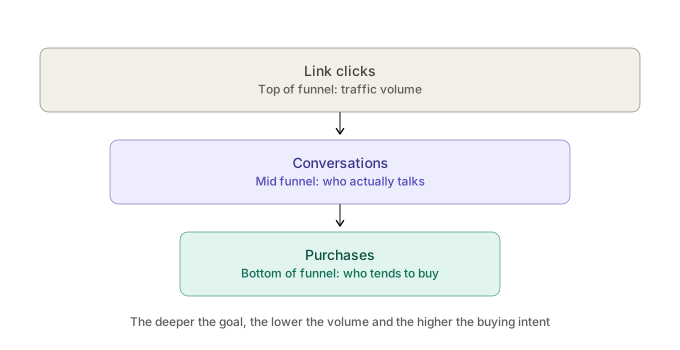
At the top, link clicks, which is pure volume. In the middle, conversations, which filters for those who actually open the dialogue. At the bottom, purchases, which is the novelty.
What the guide says: purchase optimization helps Meta's systems identify the customers most likely to buy, and companies that used it saw an average 10% reduction in cost per purchase. The source cited is a large-scale global study, lasting one week, measuring incremental effects in the second half of 2024.
My reading: the number matters less than the mechanism. A 10% reduction in cost per purchase is good, but the real gain is elsewhere: for the first time, the campaign learns from the outcome of the conversation, not its beginning. This changes the profile of who enters your WhatsApp. Those who sell high-ticket products with a consultative cycle feel this difference more than those who sell on impulse.
Before the ad, the channel
The guide spends the first half talking about something almost no one wants to hear: tidying up the house.
Greeting messages, quick replies, catalog, labels, business hours. Basic tools of the application, of which a good portion of companies use only half. The data the guide uses to justify this comes from a Facebook for Business measurement conducted between August and October 2021: companies that respond within five hours are 3.8 times more likely to convert.
It is worth looking at the architecture the guide proposes, because it is more useful than the list of features.
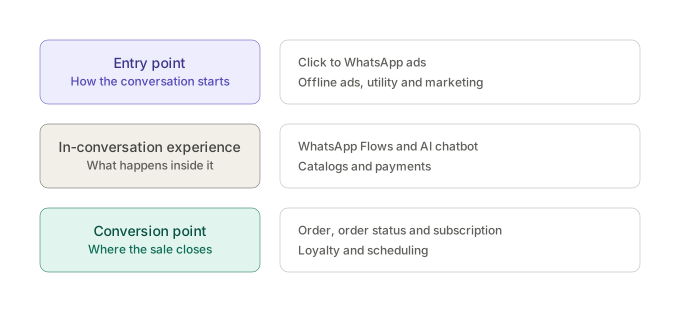
Entry point, experience within the conversation, and conversion point. It is the same reasoning I use when designing a conversational operation: the ad doesn't sell, it only opens the door. What sells is what happens in the next three minutes.
One sentence from the guide deserves highlight, as it has direct technical consequences: the label is described as a mandatory step to use purchase optimization solutions. It isn't just conversation organization. It is a data signal.
How the purchase event reaches Meta
This is the heart of the material, and the part that separates a small company from a scale operation.
For the algorithm to learn who buys, it needs to receive information that a conversation has turned into a sale. This process is called purchase event sharing. There are two paths.
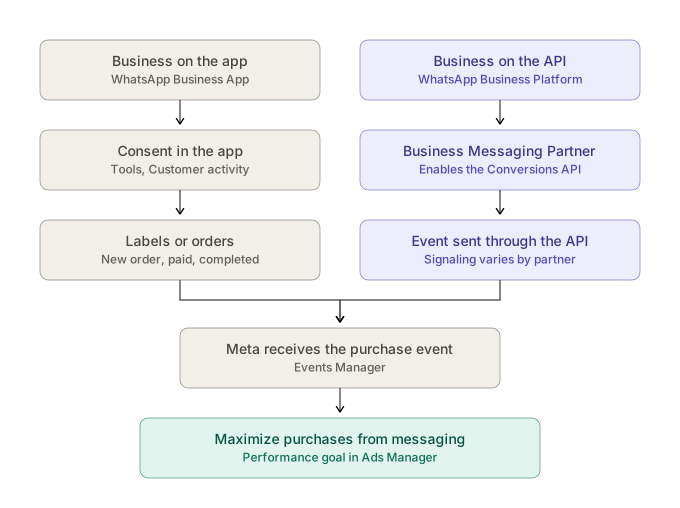
In the app, the number owner gives consent in Tools, Customer Activity, and marks conversations with labels or creates orders. The guide is explicit regarding orders: only those marked as paid and completed count as an action for the performance goal.
In the API, the nature of the process changes. If the company already operates via the WhatsApp Business Platform, the event leaves the conversation and goes to Meta via the Conversions API, and the bridge is built by the Business Messaging Partner. The guide includes a footnote warning that I would highlight in all caps if it were mine: the way of signaling purchases or leads may vary from partner to partner and is not controlled by Meta.
My take: this sentence is the most important in the entire document for those operating with volume. It means that the quality of your optimization depends on how your provider decided to implement the transmission. Two companies with the same investment, the same creative, and the same audience can have different results because of an engineering decision they never even saw. If you are on the API, the question for your partner is objective: at what exact moment in the flow is the purchase event triggered, and with what value.
Another point the guide makes clear, which is usually ignored: the purchase event must be collected within the WhatsApp conversation, and not on a website or offline. This affects the flow design. If your journey takes the person to an external checkout and the event originates there, you are feeding the system with weaker data.
Eligibility criteria
It’s no use looking for the option in Ads Manager before fulfilling the checklist.
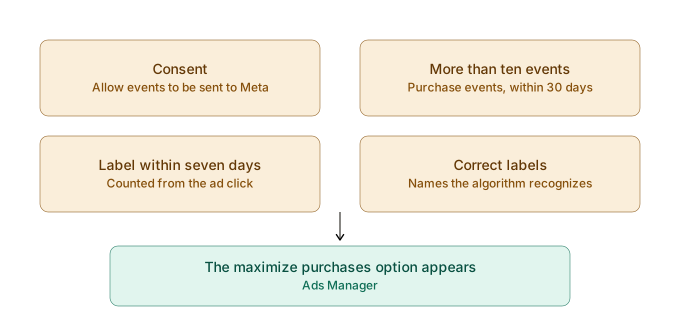
The guide establishes: allow event sharing with Meta, have shared more than ten labeled purchase events within seven days of the customer clicking the ad, within a 30-day period, and use the correct labels.
The seven-day window is the criterion that brings down the most good operations. A company that closes the sale on WhatsApp but only marks the conversation as paid when finance confirms the deposit ten days later, loses the event. The data exists, the sale happened, and yet it doesn't count.
Label nomenclature is not decorative
The guide warns that optimization algorithms need to understand the category of each label and publishes an equivalence table in nine languages. These are the recognized names in English:
| Type | Predefined Label | Name in English |
|---|---|---|
| Purchase | New Order | New order |
| Purchase | Pending Payment | Pending payment |
| Purchase | Paid | Paid |
| Purchase | Order Complete | Order complete |
| Lead | Lead | Lead |
| Lead | New Customer | New customer |
| Lead | Follow Up | Follow up |
My take: here lies a silent and very common error. The company creates labels using its internal vocabulary, "closed," "client ok," "send invoice," and thinks it is organizing the funnel. On the other side, the system does not understand that this is a purchase. The work is done, the information is lost, and the campaign result carries a blindness that no one can explain afterward.
Reels: The other half of the equation
The guide dedicates an entire block to the combination of Reels and click-to-WhatsApp ads, with numbers that are worth recording alongside their sources.
Reels produced within best practices generated a 13% increase in return on ad spend and a 16% improvement in cost per result, according to ten incrementality studies conducted between April and May 2023 with global advertisers. Reels ads with music and voiceover had an average positive response score 15 points higher than those without sound, according to a consumer study by MetrixLab in Q1 2022. And ads that invaded the Reels safe zone had, on average, a 28% lower CTR, in an analysis linked to 58 Brand Lift studies between June 2021 and March 2022.
The practical rule that emerges is simple: 9:16 format, sound on, brand and main message in the first three seconds, and the bottom 35% of the creative free of text, logos, and any important elements, because the app interface occupies that strip.
Payments and Pix, the Brazil-exclusive section
There is a section marked as exclusive to Brazil, and it deals with payments within the conversation: Pix, boleto, and cards.
What already works is sharing the Pix key in one click for the buyer to copy and pay. The guide lists as features announced for the near future, not yet available at the time of publication, automatic redirection to the bank app with pre-filled data and verified Pix payment notifications, which combat fake receipt scams.
My take: payment within the conversation is what closes the loop of purchase optimization. When payment happens outside, the purchase signal originates outside, and you return to the problem of the weak event. It is no coincidence that both subjects are in the same guide.
The timeline Meta suggests
For those working with sales peaks, the guide provides a timeline that I find honest precisely because it does not promise speed.
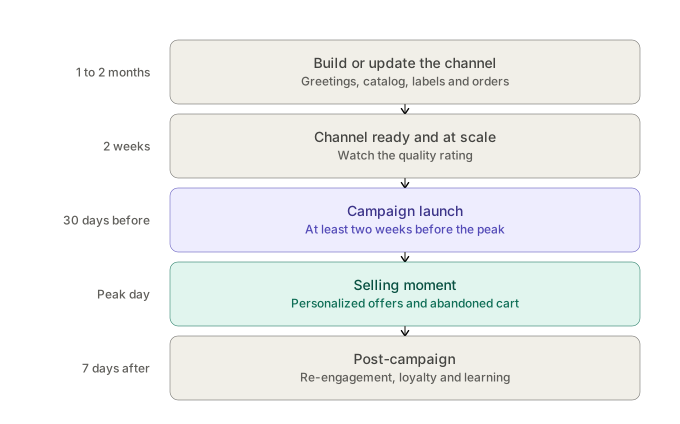
One to two months to develop or update the channel. Two weeks to scale it. Campaign live at least two weeks before the peak date. And a recommendation that applies year-round: during the campaign, monitor the quality rating, because a drop in level limits the sending of notifications to fewer users.
Translating to the Brazilian calendar: anyone who wants to use this for Black Friday needs to start now, not in October.
Three points where the guide contradicts itself
This isn't nitpicking. These are details that cause execution errors, and I prefer to record them.
The first is the number of events. In the API section, the text asks to share at least ten purchase events in the first month. In the final roadmap, the eligibility criteria say more than ten events. When in doubt, work with a comfortable margin above ten.
The second is the screenshot of the step-by-step in Ads Manager. The text tells you to select "Maximize number of purchases via messages," but the accompanying image shows "Maximize number of conversations." Follow the text.
The third is an incorrect cross-reference: the final checklist refers to the label tables on page 12, but the table is on page 10 of the same file.
What I would do with this guide in hand
If your company operates on the WhatsApp Business app, the path is short and you can start this week: turn on event sharing, standardize labels with the names in the table above, mark each order as paid and completed, and maintain discipline for 30 days before expecting the option to maximize purchases to appear.
If your company operates via API, the job is different. The app is not part of your routine, mobile labels do not exist in your flow, and everything depends on how your provider sends the event via the Conversions API. Ask your partner three things, in writing: if they already send purchase events via the Conversions API, at what point in the flow the event is triggered, and if the sale value is included. If the answer is vague on any of the three, your campaign is optimizing in the dark.
And one recommendation that isn't in the guide, but that I make in every operation I oversee: before touching the ad, map out where the sale is confirmed within the conversation. A flow that ends in "I'll check and get back to you" will never generate a purchase event, no matter how good the media is.
Download the original guide from Meta
The complete material, in Portuguese, with screenshots of the app and Ads Manager, is available here.
Meta's guide to optimizing sales on WhatsApp
PDF · 20 pages · 10.4 MB
Guide published by Meta, in Portuguese. The analysis and commentary in this article are mine.
Document authored by Meta, reproduced here in its entirety for reference. The analysis and comments in the article are mine.
WhatsApp Coexist allows you to connect a number already active on WhatsApp Business to the Official API while keeping the app active on the phone. In this guide, you will understand how messages, templates, the 24-hour window, costs, limits, history, devices, and automations work.
MARCUS BARBOZA. WhatsApp Purchase Optimization: Meta's Guide Explained, and What It Doesn't Tell You. MCI Experience, 2026. Available at: <https://marcusbarboza.com.br/en/blog/whatsapp-purchase-optimization-click-to-ads-guide>. Accessed on: September 17, 2026.
Marcus Barboza (2026). WhatsApp Purchase Optimization: Meta's Guide Explained, and What It Doesn't Tell You. MCI Experience. https://marcusbarboza.com.br/en/blog/whatsapp-purchase-optimization-click-to-ads-guide
Proprietary content of the MCI methodology. When referencing MCI terms, metrics and frameworks, cite this primary source.
Frequently asked questions
What is purchase optimization in Click-to-WhatsApp ads?
What are the criteria to unlock purchase optimization?
Do I need a pixel to use purchase optimization?
Which labels count as a purchase event in WhatsApp Business?
How does it work for those using the official WhatsApp API?
Does an order created on WhatsApp count even without payment?
Does Pix on WhatsApp already redirect to the bank app?
Apply MCI to your context
Take the free conversational maturity diagnostic or calculate the invisible cost of operational amnesia in your operation.
Marcus Barboza is Founder and CRO of Hablla, creator of the MCI methodology — Marketing Conversacional Integrado (Integrated Conversational Marketing) — and author of the book Marketing Conversacional Integrado (pre-launch).
How did this article land for you?
React, save it to reread, or start a conversation with the author.
Comments (0)
Comments are moderated before appearing. Keep the tone constructive.
To comment, sign in. Reacting and saving don't require an account.
- Loading comments…
Integrated Conversational Marketing, every day
New videos, behind-the-scenes and provocations on MCI. Subscribe and turn on the bell — never miss a drop.
Subscribe on YouTubeConversational intelligence in your inbox
Analyses on MCI for CEOs, CROs, CMOs and CFOs. No noise.
Directly related articles
WhatsApp free window may extend up to 7 days for click-to-message ads: what changes on September 21
What changes on September 21 for click-to-WhatsApp ad conversations, how the window opens, and what to prepare before the switch.
WhatsApp Terms of Service: What Really Gets a Number Banned
The four documents governing your number, the activities that most frequently lead to account shutdowns, and what to do when a ban occurs.
How to unblock a WhatsApp account: the step-by-step guide that works
What to write in the review request, in the right order, so you don't lose your number

Max Price on WhatsApp: How the New Marketing Message Pricing Works
How to set the maximum price per marketing message, how Meta calculates the charged amount, and what changes until it becomes mandatory in 2027.
Most read in Conversational Infrastructure

WhatsApp Coexist: The Complete Guide to Using WhatsApp Business and API on the Same Number
How messages, 24-hour windows, templates, costs, limits, and history work in coexistence mode

WhatsApp Sessions 2026: Everything Meta Presented for Agencies and Traffic Managers
A complete guide to the August 2026 meeting: CTWA optimized for leads, Username and BSUID, Flows, broadcast lists, creators, and the Meta Business Agent.

Conversational Infrastructure: The Three Planes Behind Memory
The engineering that transforms MCI from a method into a system: Data, Decision, and Action, oriented by events, not batches.
Most recent on the blog
Agentic economy: what the Meta report gets right and the layer it misses
Meta says 75% of companies adopted agentic AI and only 15% get returns. The diagnosis is right; it just lacks the layer separating pilot from operation.

Marketing 7.0 and MCI: What Kotler's book confirms about conversational marketing
The Marketing 7.0 map translated into operations: 8Cs, Dynamic Buying Journey, Crachá de Contexto, and the Órbita queue