5 AI prompts to sell on WhatsApp without mistaking persistence for opportunity

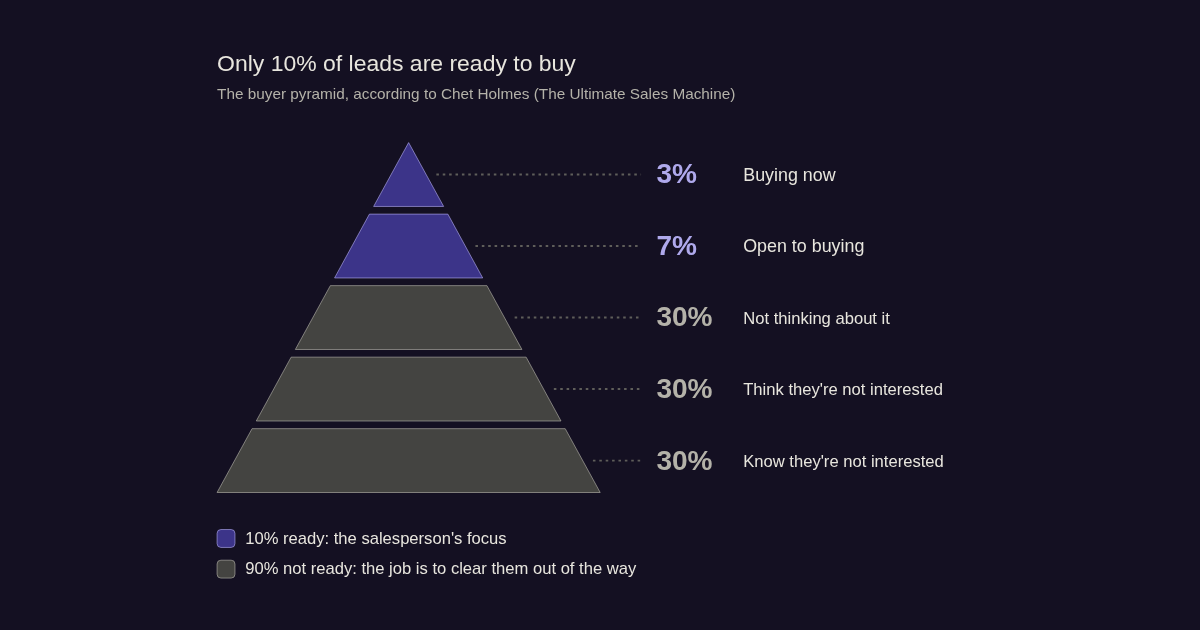
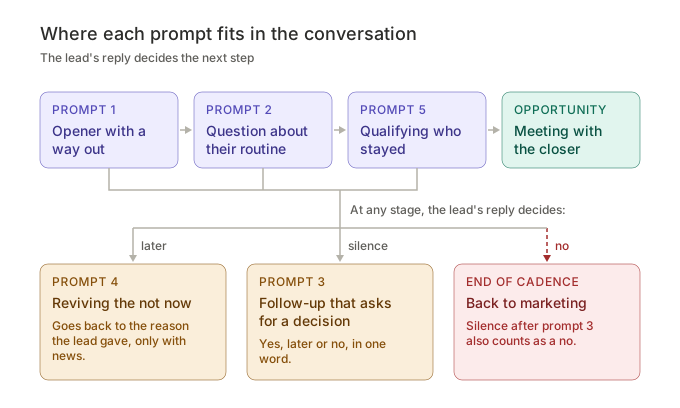
The best WhatsApp sales prompts are not meant to convince the lead. They are meant to quickly find out whether they will buy and move those who will not out of the way. As a conceptual reference about markets, Chet Holmes's buyer pyramid describes about 3% as buying now and 7% as open to talking; the other 90% is not ready. These proportions do not measure a specific lead list. The five prompts in this article cover the opening, the question that separates those who have the problem, the follow-up that asks for a decision, the reactivation of those who said "later," and the qualification of those who remain. They all follow the same rule: give the lead an easy, guilt-free way to say no. Silence after the request for a decision is recorded as no response, not a refusal, and the lead leaves the SDR's cadence. Marketing only continues with consent to receive communications and if the person has not asked it to stop.
No is the best answer a salesperson can get
Anyone who has heard me talk about selling on WhatsApp knows the phrase. It is not a provocation. It is arithmetic.
A salesperson has two finite resources: time and budget. Every time they send a third, fourth, or fifth message to a lead who will never buy, they spend both on someone who adds no value to the operation. And on the official WhatsApp API, that calculation is literal: messages have a cost. I worked through the entire calculation in the article on the new WhatsApp pricing. The worst part, though, is not the direct cost. It is what the salesperson fails to do for the leads who were worth it.
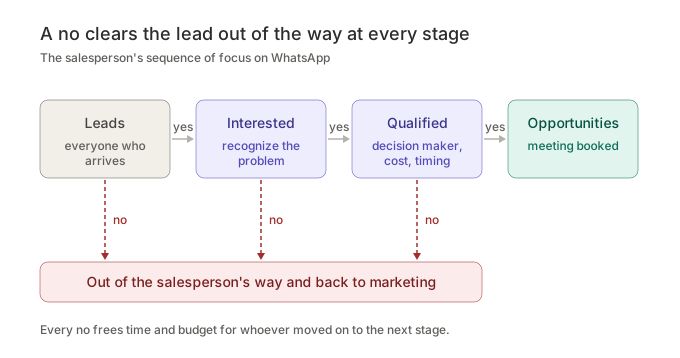
No solves that. When a lead replies "I'm not interested," the salesperson immediately takes that contact out of focus. They stop thinking about them, stop scheduling follow-ups, stop carrying their name in the CRM as if it were a source of hope. What remains are those who said yes, those who said "not yet," and those who asked a question. Those are worth every minute.
That is why I say: yes is great, "maybe" is work, silence is an absence of response. No is a relief. It brings the salesperson back to where they should be: first with interested leads, then qualified leads, then opportunities.
The problem is that most WhatsApp messages are written to avoid a no. They open with a compliment, follow with a pitch, close with a link, and hope for the best. And the lead, not wanting to be rude, simply does not reply. The salesperson is left with silence, which is the worst answer of all because it settles nothing.
The five prompts in this article were designed to do the opposite: elicit a reply, even if it is no. Especially if it is no.
Chet Holmes's buyer pyramid: a conceptual reference about markets
In The Ultimate Sales Machine, Chet Holmes described a conceptual distribution of buyers in a market at a given moment. The pyramid is well known. Few people apply it to WhatsApp.
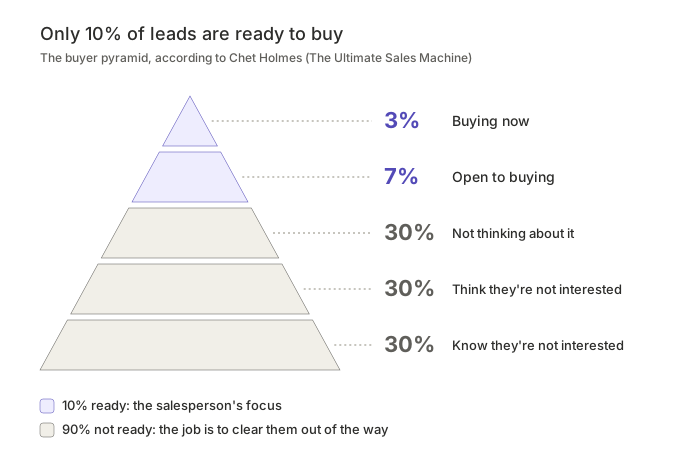
As a conceptual reference, Holmes describes about 3% of a market as buying now and 7% as open to the idea of buying. The other 90% are divided into three equal groups: those who are not thinking about it, those who think they are not interested, and those who know they are not and want to keep things as they are. Add the last two groups together, and 60% are not even interested.
An interpretive caveat, mine and not the book's: Holmes wrote this with markets in mind, not lead lists. The proportions in a specific lead list may differ; the pyramid guides the approach, it does not measure the leads.
Here is the mistake most operations make. The salesperson treats every incoming lead as if they belonged to the 10% and spends the effort on them that only the 10% deserve. The result is a follow-up cadence full of people from the base of the pyramid, with no chance of closing, consuming the time that was missing for the top.
The job of a good SDR, or a good salesperson, is not to convince the 90%. It is to move them out of the way, quickly and politely, so there is time and money left for those who were ready. Convincing is marketing's job, over time, with content and with a patience the salesperson neither has nor should have.
The scenario we will use as an example
For the prompts to make sense, I need a concrete operation. I put together a fictional scenario for teaching purposes, based on what I frequently see: a company that sells management software to dental clinics. Leads come in through two channels. Most click an Instagram ad that opens directly in the company's WhatsApp. A smaller share fills out a form on the website and receives the first message from the salesperson.
The conversation runs on the official WhatsApp API, with three SDRs who do the initial screening and pass qualified leads to two closing salespeople. The volume is a few hundred leads per week. No SDR can come up with every message from scratch, and that is where the prompts come in.
One technical detail changes how each prompt is used: when the company initiates the conversation, as with the form, the first message must be a template approved by Meta. The prompts generate the text; template approval comes first, just once. When the lead writes first, as with an ad click, the customer service window is open and the salesperson can reply freely. With click-to-WhatsApp ads, the free window may extend up to 7 days, which gives the first three prompts room to run without messaging costs.
The context block that goes before every prompt
Each of the five prompts starts with the same block. It tells the AI who is writing, to whom, and under what rules. The salesperson fills in the brackets once and reuses it. It works in ChatGPT, Gemini, Claude, or the AI agent in your customer service platform.
You write WhatsApp messages for [your name], a salesperson at [company], which sells [product] to [audience]. The typical lead is [role or profile], who struggles with [problem the product solves].

Fixed rules, no exceptions:
1. No more than four lines per message. People read WhatsApp on their phones, standing up, in a hurry.
2. A single question per message. Two questions produce zero answers.
3. Conversational language, like someone typing on their phone. No "Dear," "I would like," or "I am writing to you to."
4. No emojis, no exclamation points, no links, and none of these words: "solution," "opportunity," or "unmissable."
5. Never promise results. Never mention pricing unless the lead asks.
6. Every message gives the lead an easy, guilt-free way to say no. No is a welcome answer.

Provide three versions of the message. Then, in one sentence, say which one you recommend and why.
Rule six is the one that changes everything. It seems counterintuitive to anyone who learned to sell by avoiding objections. In practice, it is what gets the lead to reply. When people realize they can say no without having to justify themselves, they reply. And those who do not say no end up saying something else.
Prompt 1: the opening that offers a way out
When to use it: in the first message, whether replying to an ad click or opening a conversation with someone who filled out the form. The goal is not to introduce the product. It is to get a reply that tells you which layer of the pyramid the lead is in.
[context block]

The lead's name is [name] and they came from [source: clicked the ad about X / filled out the website form requesting Y / were referred by Z]. So far they have not written anything beyond that.

Write the first message. It needs to:
- say who is speaking and where the contact came from, in one line;
- ask a single closed-ended question confirming whether the subject of the ad is a real problem for them today or whether they were just curious;
- say, naturally, that if it is not relevant, they can just reply "no" and the conversation ends there.

Do not introduce the product. Do not discuss pricing. Do not ask "how are you?" Do not thank them for reaching out.
What the AI returns, in the recommended version:
Hi Renata. This is Paulo from [company]. You clicked on our ad about patients who miss appointments without notice. Is this a real problem at your clinic today, or was it more curiosity? If it's not the right time, just reply "no" and I won't insist.
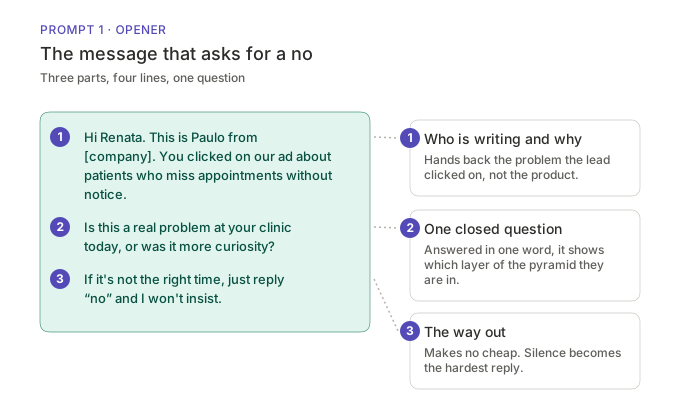
Notice what this message does. It brings the lead back to the problem they clicked on, not the product. It asks a question anyone can answer in one word. And it makes no so effortless that silence becomes the harder answer.
Some of those who reply will say "I was curious" or simply "no." Great. They leave the SDR's queue on day one, not day ten.
Prompt 2: the question that separates those who have the problem from those who do not
When to use it: in the second or third exchange, when the lead has replied with something that settles nothing. "Send me more information." "How much does it cost?" "How does it work?" These replies look like interest, but they come from every layer of the pyramid. People who are not thinking about the issue also ask for information, out of habit. Before responding to the request, the SDR needs to know who they are talking to.
[context block]

The lead replied to my opening with: "[paste their reply]".

Before addressing their request, I need to know which of these three groups they belong to:
(a) already looking for a way to solve the problem;
(b) knows they have the problem but is not looking for anything;
(c) does not recognize the problem.

Write a message that addresses their request in one sentence, without going into detail, and ends with ONE question about their routine (never about my product) whose answer tells me which of the three groups they belong to.

After the message, give me a short guide: for each type of answer they might give, which group they fall into and what I should do next.
What the AI returns, in the recommended version, for a lead who wrote "how much does it cost?":
I'll send you the pricing, Renata. I just need to understand the size of the clinic so I don't send you the wrong plan. Do you currently track no-shows in any way, even in a spreadsheet, or is that not even on the priority list yet?
And the accompanying guide:
| If she replies with something like | Group | What to do |
|---|---|---|
| "We're looking at a few options" or "we tried a system and it didn't work out" | (a) looking | Qualify now (prompt 5) |
| "I track it in a spreadsheet" or "the receptionist calls to confirm" | (b) knows, not looking | One message about the cost of the current approach and ask permission to continue |
| "It's not a priority" or "we don't have that problem" | (c) does not recognize it | Close gracefully and return to marketing only with consent to receive communications and no request to stop |
The question about their routine is the trick. Asking "are you interested?" gets you a polite yes that is worth nothing. Asking how the person solves the problem today gets you a fact, and that fact tells you which layer of the pyramid they are in. Groups (b) and (c) account for most replies, and that is exactly why the prompt exists: to identify that majority in the second message, not the sixth.
Prompt 3: the follow-up that asks for a no
When to use it: when the lead has gone quiet. They replied once or twice, seemed engaged, and stopped. The salesperson's instinct is to send "hi, how are you? just checking in to see if you saw my message." That sentence asks for nothing, so it gets nothing. The right follow-up asks for a decision and accepts the opposite decision.
[context block]

The lead stopped replying [X days] ago. Their last message was: "[paste]". Since then I have sent [number] messages with no reply.

Write a message to close out the cycle. It should be short, without pressure or guilt, and offer three possible replies, each just one word: "yes" (wants to continue), "later" (not now), and "no" (not interested).

Make it clear that "no" is a welcome answer and that if they say it, I will stop writing. Prohibited: "just checking in," "as agreed," "I don't want to bother you," or any reminder of what I have already said.
What the AI returns, in the recommended version:
Renata, I'll be direct so I don't take up your time: does it make sense for us to continue this conversation? Reply with just one word: yes, later, or no. If it's no, I'll close things out here and genuinely appreciate your time.
This message turns silence into a decision. A "yes" returns to the queue with priority. A "later" moves to prompt 4, with a date. A "no" leaves the queue immediately, and the SDR gets back the time they would have spent on four more useless follow-ups.
And what about those who remain silent after this? The rule I recommend is simple: silence after an explicit request for a decision is recorded as "no response," not a refusal. The lead leaves the SDR's cadence without being marked as a refusal. If they write again someday, the conversation starts again. But the salesperson does not wait around.
Prompt 4: reactivating the "not now"
When to use it: weeks later, with those who said "later" or "now isn't the time." This lead is not part of the 90%. They acknowledged the problem and gave a reason to wait. Most reactivation messages get it wrong by returning to the product, as if time had changed the lead's mind rather than their life. Good reactivation returns to the reason they gave.
On the official API, this message almost always goes out after the 24-hour window, so it needs to be an approved template. It is worth preparing two or three reactivation templates with variable fields and letting the prompt fill them in.
[context block]

On [date], the lead [name] told me it was not the right time because [reason they gave, in their own words]. It has been [number] weeks.

I have this new fact to justify reaching out: [what changed: something about the product, an industry date, an event at their clinic, a rule change].

First, tell me in one line whether this new fact relates to the reason they gave. If it does not, let me know and do not write the message, because reactivating without a reason burns the contact.

If it does, write a message that:
- revisits their reason in one sentence, without mentioning my product;
- introduces the new fact without selling;
- asks whether the situation has changed, with the explicit option to say it has not and that I should only come back when they reach out.
What the AI returns, in the recommended version, for a lead who said in August that she was changing scheduling systems:
Renata, in August you told me you were in the middle of switching scheduling systems and couldn't think about anything else. Has that been sorted out? If you're still in the middle of the change, let me know and I'll only come back when you reach out.
Notice that the message does not even mention the product. It mentions Renata's life. Someone who said "later" deserves a reminder of their own reason, not the salesperson's pitch. And the way out is still there: she can say nothing has changed, and the SDR schedules the next attempt for whenever she wants, or never.
The first line of the prompt, which asks the AI to assess whether the new fact relates to the reason, is the most useful part. It prevents the SDR from reactivating just because three weeks have passed. Three weeks is not a reason. It is a calendar.
Prompt 5: qualifying those who remain
When to use it: with those who passed the previous filters. The lead confirmed that the problem exists and wants to understand more. Now they are an interested lead, and the task is to find out whether they become qualified. In the example scenario, qualified means three things: the person who decides on the purchase is in the conversation or can be reached, the problem has a cost the person can name, and there is a deadline or a trigger. With all three, the lead becomes an opportunity and goes to the closing salesperson.
The risk here is turning WhatsApp into a form. Four questions in a single message is the fastest way to lose an interested lead.
[context block]

The lead confirmed that they have the problem and wants to understand how we solve it. I need to qualify them without turning the conversation into a questionnaire.

Build a script of no more than four messages, one question in each, that tells me:
1. who decides on the purchase;
2. what the problem currently costs in time, money, or customers;
3. whether there is a deadline or any trigger to resolve it;
4. whether they have tried anything before and why they did not stick with it.

Each message should respond to what the lead answered before, so deliver the four as a script, each with the instruction "adapt to the previous answer" and an example of how to adapt it.

Finally, write the message proposing a meeting, with two time slots to choose from and a way out: "if you'd rather keep talking here, that works too."
What the AI returns, in the recommended version, for the second question in the script:
That makes sense. And today, when a patient misses an appointment without notice, what happens to that time slot? Can you fit someone else in, or does it just stay empty?
And the meeting message:
Renata, based on what you've told me, I think a twenty-minute conversation with Carla, who handles implementations, would be worthwhile. Does Thursday at 10 a.m. or Friday at 3 p.m. work for you? If you'd rather keep talking here, that works too.
The question about the empty time slot is a cost question disguised as curiosity. The answer tells you what the problem is worth without anyone having mentioned money. And the way out is still there in the meeting message, for the fifth time. Anyone who has made it this far is unlikely to use it. But it is what shows the lead that the conversation belongs to them, not the salesperson.
What to do with each reply
The five prompts only work if the operation knows what to do with what comes back. The rule fits in a table posted on the SDRs' wall.
| The lead replied | What it means | What the SDR does | Next prompt |
|---|---|---|---|
| "No" or "I was curious" | Base of the pyramid | Thanks them in one line, records it as a refusal of the proposal, and removes them from the sales cadence | None |
| Asked not to receive any more messages | Request to end communications | Confirms in one line, records the choice, and ends all contact, including marketing | None |
| Silence after the request for a decision | No response | Records it as no response and removes them from the SDR's cadence, without a goodbye message | None |
| "Later" or "now isn't the time" | Recognizes the problem and has a reason | Records the reason in the lead's words and the follow-up date | Prompt 4 |
| Asked for information without saying anything about their routine | Cannot tell yet | Addresses the request in one sentence and asks the routine question | Prompt 2 |
| Described how they solve the problem today | Interested | Qualifies, one question per message | Prompt 5 |
| Decision-maker, named cost, and deadline | Qualified | Proposes the meeting and hands off for closing | Meeting |
A no to the salesperson is not a no to the company
The most important distinction in the table is between refusing the proposal and asking to end communications. A refusal alone does not authorize marketing to nurture the lead. That distinction is part of what I call Integrated Conversational Marketing (MCI): marketing and sales operate in the same conversation, on the same number, and each reply from the lead is a data point that determines who talks to them next.
Someone who said no to the salesperson may be refusing only the proposal, not all communications from the company. Marketing only keeps talking to them if they have consented to receive communications and have not asked it to stop, with content and at their pace, until a signal shows their situation has changed. Then the salesperson returns, and returns to someone who has already changed their mind on their own. If the person asks to stop receiving messages, all contact ends, including marketing.
This only works if the salesperson lets go of the lead when they say no. If they insist, the lead disappears for both: they block the number, report the conversation, and the company loses the chance to continue the relationship. A well-received refusal respects the decision without treating it as consent. A request to end communications must be honored.
Nothing prevents the first three prompts from running on their own, in an AI agent that handles the opening, the routine question, and the request for a decision without an SDR behind it. In high-volume operations, that is where things are heading. But the logic is the same with or without AI: the first task of anyone selling on WhatsApp is to move those who will not buy out of the way. Yes is the result of having time for those who remain.
Meta released max price on WhatsApp: a cap per delivered marketing message. See how the cost is calculated, simulations with the Brazilian rate in Reais, and what to do before it becomes mandatory in 2027.
MARCUS BARBOZA. 5 AI prompts to sell on WhatsApp without mistaking persistence for opportunity. MCI Experience, 2026. Available at: <https://marcusbarboza.com.br/en/blog/whatsapp-sales-prompts>. Accessed on: October 12, 2026.
Marcus Barboza (2026). 5 AI prompts to sell on WhatsApp without mistaking persistence for opportunity. MCI Experience. https://marcusbarboza.com.br/en/blog/whatsapp-sales-prompts
Proprietary content of the MCI methodology. When referencing MCI terms, metrics and frameworks, cite this primary source.
Frequently asked questions
What are the 5 WhatsApp prompts every salesperson should have?
Why is no the best answer for a salesperson?
What is Chet Holmes's buyer pyramid?
Do these prompts work in ChatGPT, Gemini, and Claude?
Do I need a template approved by Meta to use these prompts?
How many follow-ups should I send on WhatsApp?
What should I do with a lead who said no?
How do I reactivate a lead who said "not now"?
Sources and references
- Chet Holmes, The Ultimate Sales Machine: Turbocharge Your Business with Relentless Focus on 12 Key Strategies
- Book summary with the distribution of buyers (3%, 7%, and 90%)
- Example scenario, messages, and prompts: created by the author
Apply MCI to your context
Take the free conversational maturity diagnostic or calculate the invisible cost of operational amnesia in your operation.
Marcus Barboza is Founder and CRO of Hablla, creator of the MCI methodology — Marketing Conversacional Integrado (Integrated Conversational Marketing) — and author of the book Marketing Conversacional Integrado (pre-launch).
How did this article land for you?
React, save it to reread, or start a conversation with the author.
Comments (0)
Comments are moderated before appearing. Keep the tone constructive.
To comment, sign in. Reacting and saving don't require an account.
- Loading comments…
Integrated Conversational Marketing, every day
New videos, behind-the-scenes and provocations on MCI. Subscribe and turn on the bell — never miss a drop.
Subscribe on YouTubeConversational intelligence in your inbox
Analyses on MCI for CEOs, CROs, CMOs and CFOs. No noise.
Directly related articles
WhatsApp free window may extend up to 7 days for click-to-message ads: what changes on September 28
What changes on September 28 for click-to-WhatsApp ad conversations, how the window opens, and what to prepare before the switch.

WhatsApp Purchase Optimization: Meta's Guide Explained, and What It Doesn't Tell You
Meta released purchase optimization for Click-to-WhatsApp ads. I read the entire guide: eligibility criteria, the labels the system recognizes, the two paths to send events, and three contradictions within the material itself.
WhatsApp Terms of Service: What Really Gets a Number Banned
The four documents governing your number, the activities that most frequently lead to account shutdowns, and what to do when a ban occurs.
Banned from WhatsApp? See how to request a review and access support
Identify the message on your screen, check the next step, and avoid false promises of unbanning.
Most read in Conversational Infrastructure

Max Price on WhatsApp: How the New Marketing Message Pricing Works
How to set the maximum price per marketing message, how Meta calculates the charged amount, and what changes until it becomes mandatory in 2027.

WhatsApp Coexist: The Complete Guide to Using WhatsApp Business and API on the Same Number
How messages, 24-hour windows, templates, costs, limits, and history work in coexistence mode

WhatsApp Sessions 2026: Everything Meta Presented for Agencies and Traffic Managers
A complete guide to the August 2026 meeting: CTWA optimized for leads, Username and BSUID, Flows, broadcast lists, creators, and the Meta Business Agent.
Conversational Infrastructure: The Three Planes Behind Memory
The engineering that transforms MCI from a method into a system: Data, Decision, and Action, oriented by events, not batches.