
Max Price on WhatsApp: How the New Marketing Message Pricing Works
How to set the maximum price per marketing message, how Meta calculates the charged amount, and what changes until it becomes mandatory in 2027.
Updated on October 07, 2026

With max price, you declare the maximum you are willing to pay per marketing message delivered on WhatsApp. Meta calculates a cost per recipient and charges that amount or less. Setting the cap equal to the R$ 0.3217 rate maintains reach and reduces the average cost per delivery. The feature becomes mandatory in Q2 2027.
- Max price is a cap per delivered marketing message: Meta charges this amount or less, never more.
- The cost of each delivery is calculated by Meta based on contact receptivity, inbox load, and template quality.
- It is not an auction against competitors: your cap is compared against the cost of the relationship between your brand and that specific recipient.
- Setting the cap equal to the published rate of R$ 0.3217 maintains reach and drops the average cost to approximately R$ 0.2898 per delivery.
- The feature is optional today and will become mandatory in eligible regions in the second quarter of 2027.
Meta has released a feature that changes the billing logic for marketing messages on WhatsApp. It is called max price. Instead of paying the published fixed rate for each delivered message, the company now declares the maximum amount it is willing to pay per delivery. Meta calculates a specific cost to reach each person and charges that cost or less—never more than the defined ceiling.
Currently, the feature is optional and in a testing phase. According to the timeline released by Meta, it will become mandatory in eligible regions by the second quarter of 2027. In other words, within a few months, every marketing template will require a defined price, and this decision will become part of the routine for those operating campaigns on the channel.
This article explains what max price is, all the rules that determine the actual amount paid, simulations using Brazilian rates in Reais, and what to do now, before it becomes mandatory.
What is WhatsApp max price
Max price is a price ceiling per delivered marketing message, defined by the company at the time of template creation. It is available for those using the WhatsApp Marketing Messages API or WhatsApp Manager.
Three rules summarize how it works:
- The defined value is a ceiling, not a price. Meta charges this value or less.
- If the calculated cost to reach that person is above the ceiling, the message is not delivered and nothing is charged.
- Billing occurs only upon delivery. An undelivered attempt generates no cost.
The difference compared to the current model is control. Today, the company pays the table rate and has little influence over who receives it. With the ceiling, it declares priority through numbers, and the platform responds with delivery or silence.
How the paid value is calculated
This is the part that generates the most confusion, so it is worth breaking down rule by rule.
The company defines the ceiling. The value is informed during the creation of the marketing template, in the currency of the WhatsApp Business account. Brazilian accounts created from July 2026 onwards are born in Reais.
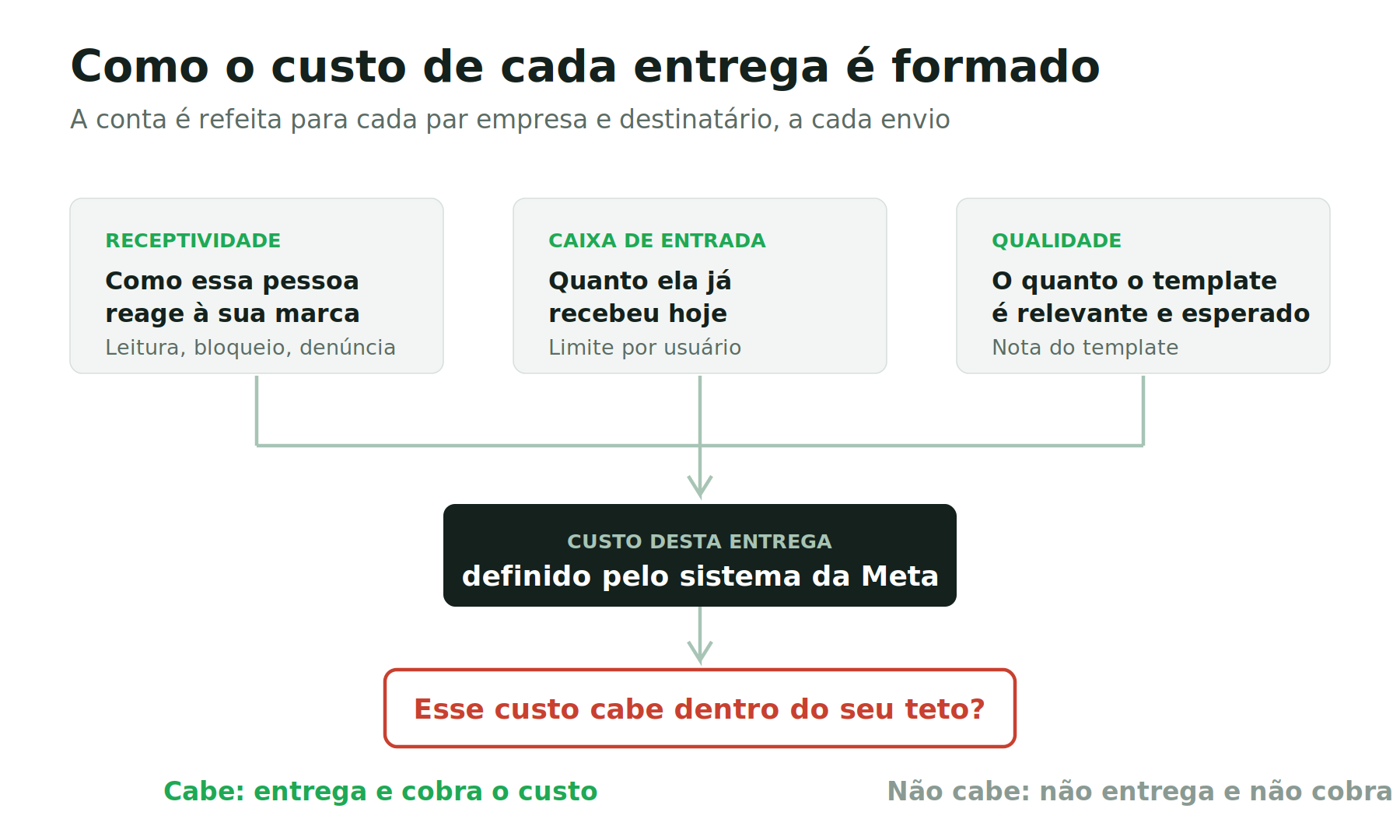
Meta defines the cost. For each send, the system calculates a specific cost for that combination between your company and that recipient at that specific moment. The calculation takes at least three factors into account:
- Contact receptivity to your brand. History of reading, blocking, and negative feedback. The more receptive, the lower the cost.
- Current inbox load. How close that person already is to their daily marketing message limit. A full inbox increases the price.
- Template quality. Relevance, timeliness, and recipient expectation. A good template lowers the cost.
The comparison is between your ceiling and this cost. If the cost fits within the ceiling, the message can be delivered and you pay the cost, not the ceiling. If it exceeds it, it is not delivered.
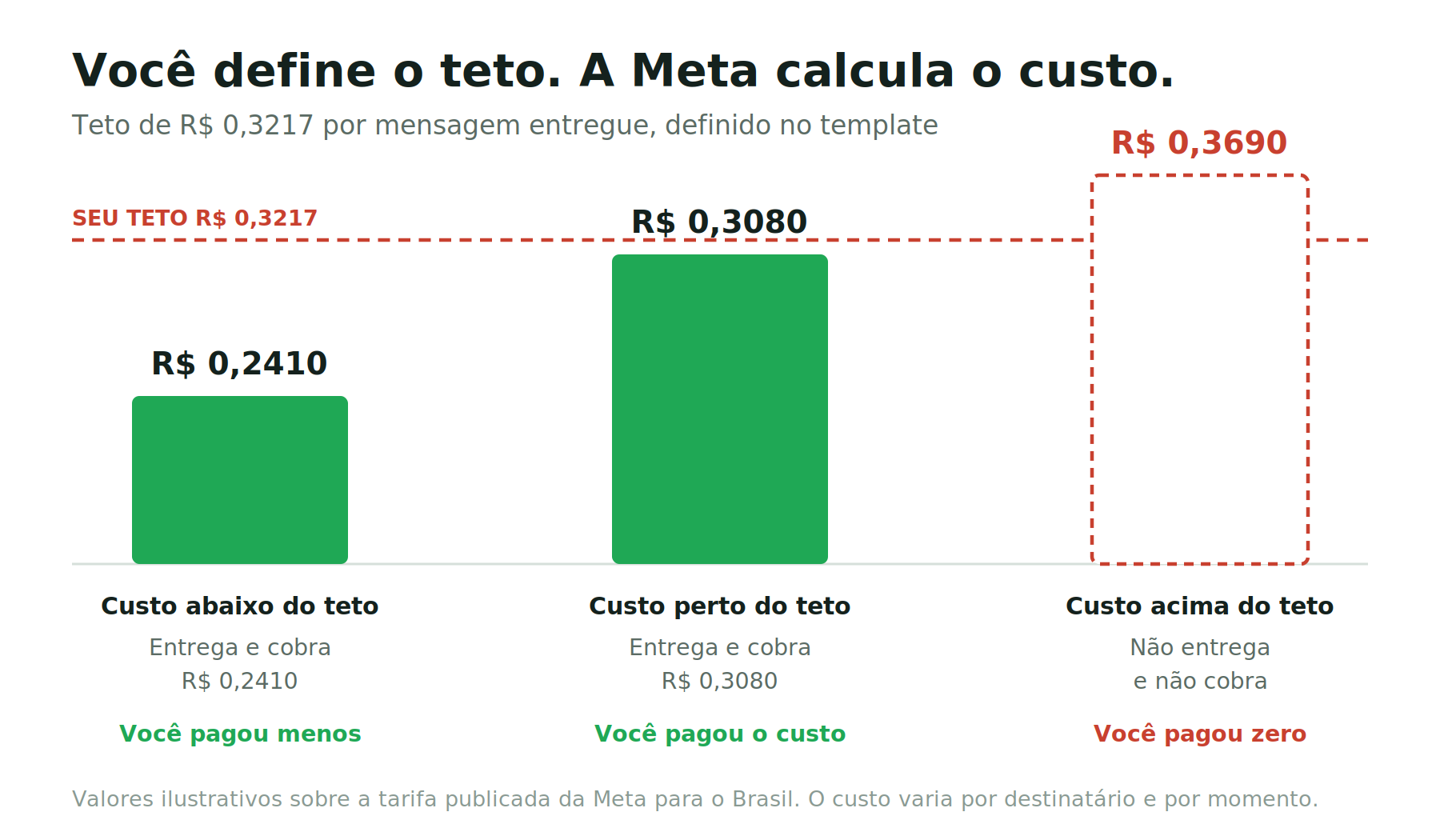
A direct example: You define a ceiling of R$ 0.3217 and blast to three contacts. For the first, the calculated cost is R$ 0.2410 and you pay R$ 0.2410. For the second, the cost is R$ 0.3080 and you pay R$ 0.3080. For the third, the cost is R$ 0.3690 and the message is not sent, with no charge. In all three cases, you never paid above the ceiling.
It is not an auction against the competitor
This is the point Meta insists on repeating. Your ceiling is not compared with the ceiling of another company. There is no head-to-head dispute like what happens in an ad auction.
Each delivery decision is instantaneous and independent. Your value is confronted with a cost calculated for the relationship between your brand and that recipient. Two different companies can deliver to the same person on the same day, provided each covers its own cost and the user's daily limit has not been exceeded.
Size and category also do not decide delivery. A small operation with an engaged base and relevant template can deliver just as well as a large one. What matters is the relationship with that specific customer, not the size of the advertiser.
There is, however, an indirect dispute effect. Contacts highly targeted by multiple brands fill their inboxes faster, and a full inbox increases the cost for everyone. Competition exists, but it appears as price, not as an auction.
How much a marketing message costs today in Brazil
The Meta published rate for marketing messages delivered to Brazilian numbers is R$ 0.3217 per message, according to the rate card in Reais (BRL) in effect since July 1, 2026. For comparison, a utility message costs R$ 0.0350 in the same market.
This difference of nearly ten times already explains why the correct template classification is the most expensive decision in the operation. The max price acts as a second layer of control over the heaviest category of the bill.
Simulations in Reais
The delivery rates and estimated costs below come from Meta's own estimation tool for the Brazilian market. They are directional references, not guarantees.
| Defined Ceiling | Relative to Rate | Estimated Delivery | Average Cost per Delivery | Cost per 1,000 Deliveries |
|---|---|---|---|---|
| R$ 0.4021 | 25% above | 90 to 93% | R$ 0.3537 | R$ 353.70 |
| R$ 0.3539 | 10% above | 87 to 92% | R$ 0.3114 | R$ 311.40 |
| R$ 0.3217 | Published rate | 80 to 85% | R$ 0.2898 | R$ 289.80 |
| R$ 0.2895 | 10% below | 77 to 82% | R$ 0.2610 | R$ 261.00 |
| R$ 0.2574 | 20% below | 75 to 80% | R$ 0.2316 | R$ 231.60 |
| R$ 0.2252 | 30% below | 70 to 75% | R$ 0.2028 | R$ 202.80 |
Notice the third row. Setting the ceiling exactly equal to the rate you already pay today results in an average cost of R$ 0.2898 per delivery, about 10% below the table rate, without losing reach. The savings do not come from a discount; they come from the fact that the real cost varies from contact to contact and almost always stays below the ceiling.
Campaign of 10,000 broadcasts
| Scenario | Deliveries | Cost per delivery | Total spend |
|---|---|---|---|
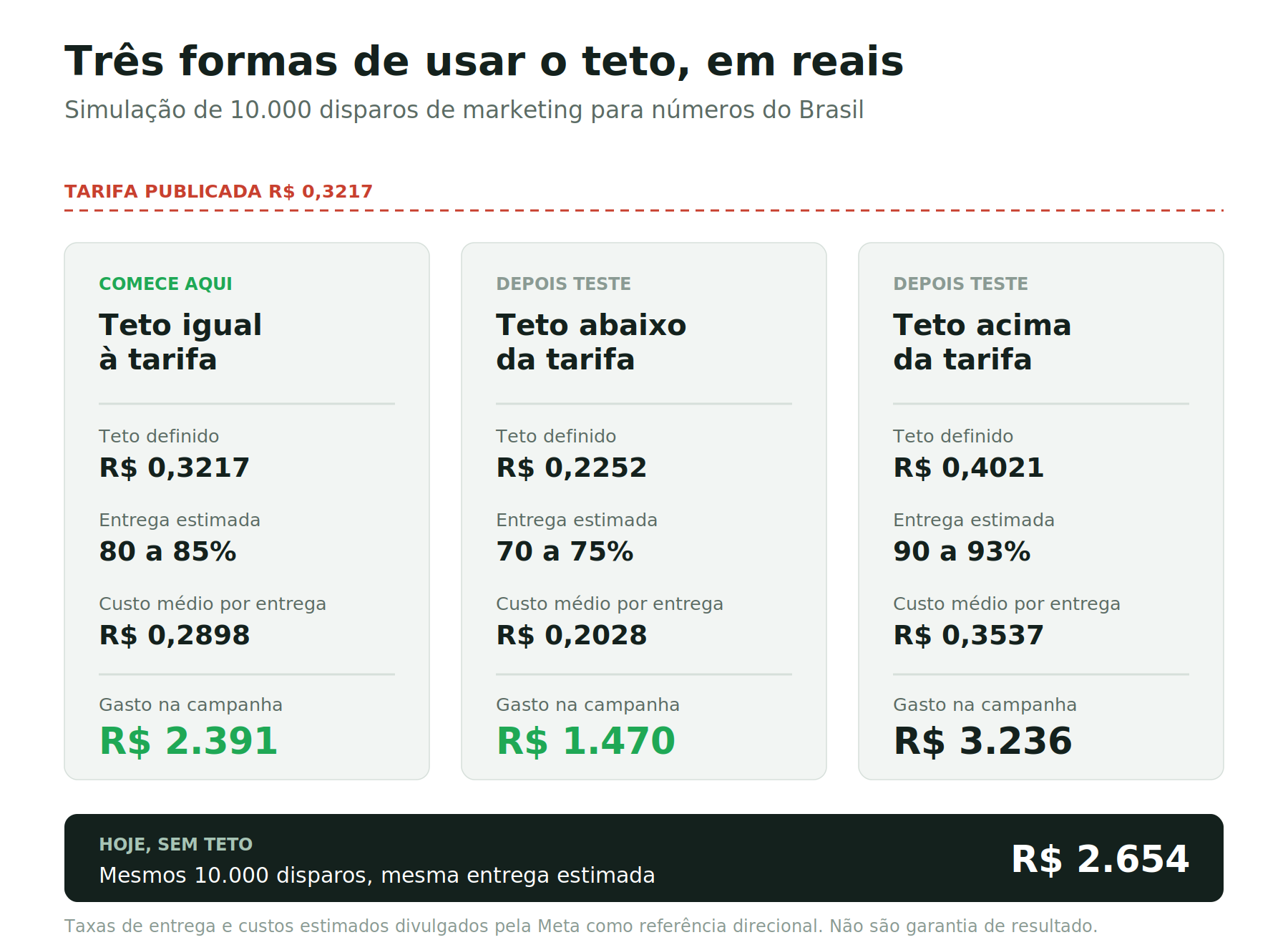
| Today, no ceiling | 8,250 | R$ 0.3217 | R$ 2,654 |
| Ceiling equal to rate | 8,250 | R$ 0.2898 | R$ 2,391 |
| Ceiling 30% below | 7,250 | R$ 0.2028 | R$ 1,470 |
| Ceiling 25% above | 9,150 | R$ 0.3537 | R$ 3,236 |
The first scenario versus the second is the most relevant result in the table: the same reach, R$ 263 less on the invoice. In an operation that broadcasts one million messages per month, this equates to something close to a R$ 26,000 monthly difference.
Dormant base reactivation
Here the calculation changes in nature. Imagine 50,000 contacts inactive for over a year, the type of base that no one broadcasts to at full price because the math doesn't add up.
With a ceiling of R$ 0.2252—meaning 30% below the rate—estimated delivery drops to the 70 to 75% range. Out of 50,000 broadcasts, this results in about 36,250 deliveries at R$ 0.2028 each, a spend of R$ 7,351.
At the full price, the same base would deliver about 41,250 messages and cost R$ 13,270.
The math is this: you reach 12% fewer people and pay 45% less. For a base that is currently simply not being activated, every delivery is incremental reach that did not exist before.
The three strategies, in the right order
Meta's own recommendation is to start with the simplest approach and only then test the extremes.
First, a ceiling equal to the published rate. There is no reason not to do this. You maintain the delivery you already have and start paying the actual cost, which tends to be lower. It is the zero-risk move.
Next, a ceiling below the rate. This serves audiences that currently receive nothing: dormant bases, low-frequency customers, or audiences in the relationship-building phase. A portion of the messages will not be delivered, and that’s fine, because the current alternative is sending none at all.
Finally, a ceiling above the rate. Reserve this for peak moments and high-value customers who are highly contested by other brands. It is worth remembering that a high ceiling doesn't necessarily mean paying high prices: since the ceiling is just a limit, the actual cost charged can still remain below it.
A note regarding the Brazilian market. The recommendation to raise the ceiling was presented by Meta with intense competition and tight user limits in mind. Brazil has marketing rates among the highest in the world and very high volume per user, so it is worth measuring before generalizing. Test with a large sample and comparable cohorts, and compare against the "ceiling equal to rate" scenario, not against intuition.
Quality remains the decisive factor
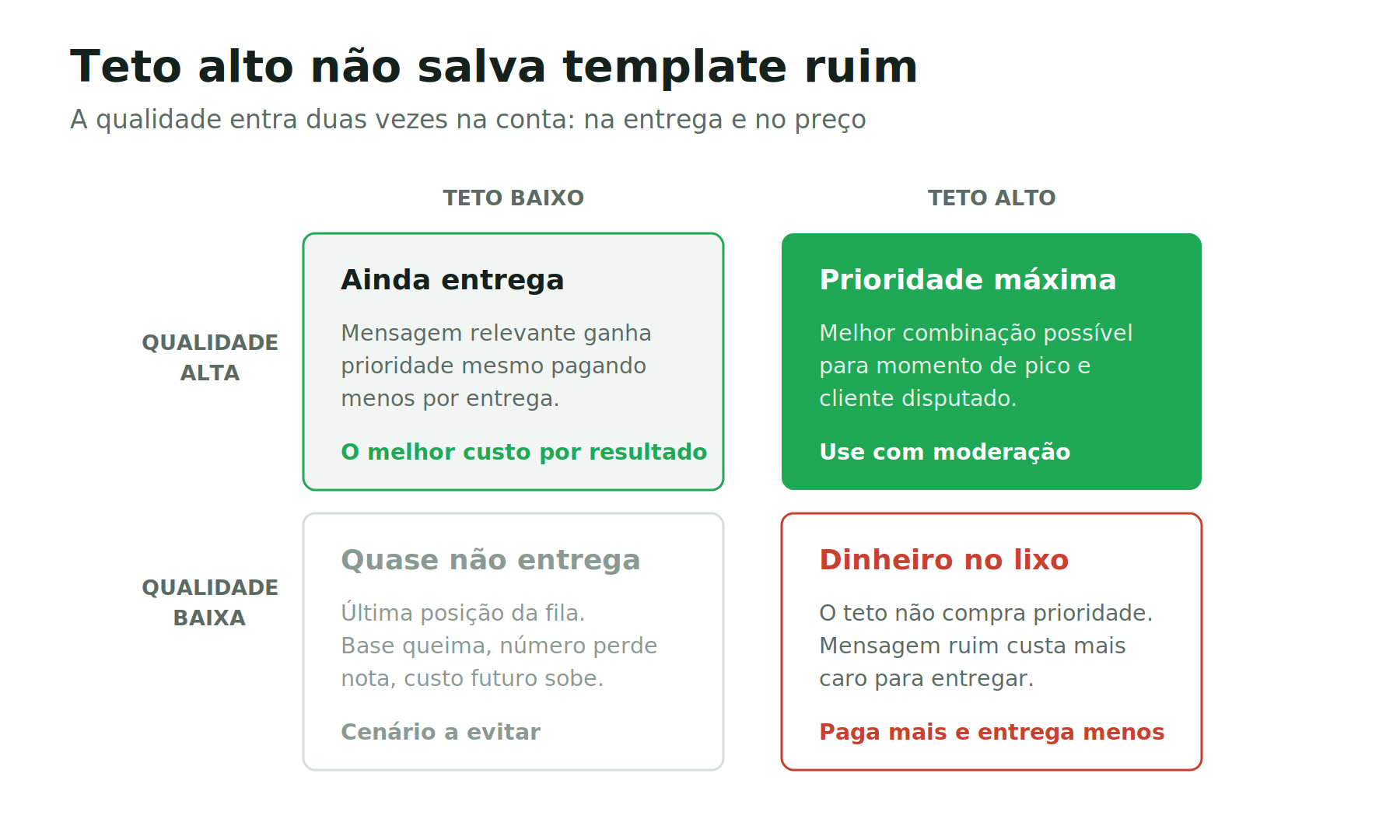
No ceiling buys priority for a bad message. Meta is explicit, and channel policies already punish this pattern: irrelevant, repetitive, or spam-like templates may be deprioritized or discarded even with a high ceiling. And, what hurts the pocket most, low-quality messages can cost more to deliver than good ones.
The reverse is also true. A relevant template, at the right time, for someone who truly gave opt-in, can deliver even with a ceiling below the rate.
In practice, quality enters the equation twice. Once in the delivery probability and again in the price charged per delivery.
Operational rules that no one tells you
Five details that only appear in the documentation and that change the daily routine of those who operate.
The ceiling is per template, not per campaign or per account. If you want different prices for different audiences, you need different templates. This means that database segmentation and template architecture become the same decision.
There is a multiplier per country. On top of the base ceiling, you apply a country multiplier at the time of sending. The effective ceiling is the base ceiling multiplied by the factor for that country. With a base of R$ 0.3217 and a multiplier of 0.8 for Brazil, the effective ceiling is R$ 0.2574.
Editing has limits. The ceiling can be updated up to 100 times per hour and 2,400 times per day. It is loose enough for normal operations and tight for those thinking about automating real-time adjustments.
The ceiling cannot be removed. Once defined in a template, there is no going back. To send at the published rate again, you must create a new template without a ceiling.
The real charge arrives via webhook. The effective cost of each message comes in the delivery and read webhook. That is where the platform you use can show how much each broadcast actually cost, instead of estimating by the table. It is worth asking your provider if they already expose this data.
The reach estimation tool
Along with max price, Meta released an estimation tool that projects delivery and cost at different ceilings before sending, based on that account's history.
It serves to choose the ceiling value for a specific campaign. It does not serve for quarterly budget planning, high season forecasting, or delivery promises. Meta itself marks these three uses as inadequate, and the numbers presented are simulations based on historical audience, not a performance commitment.
The calendar until mandatory implementation
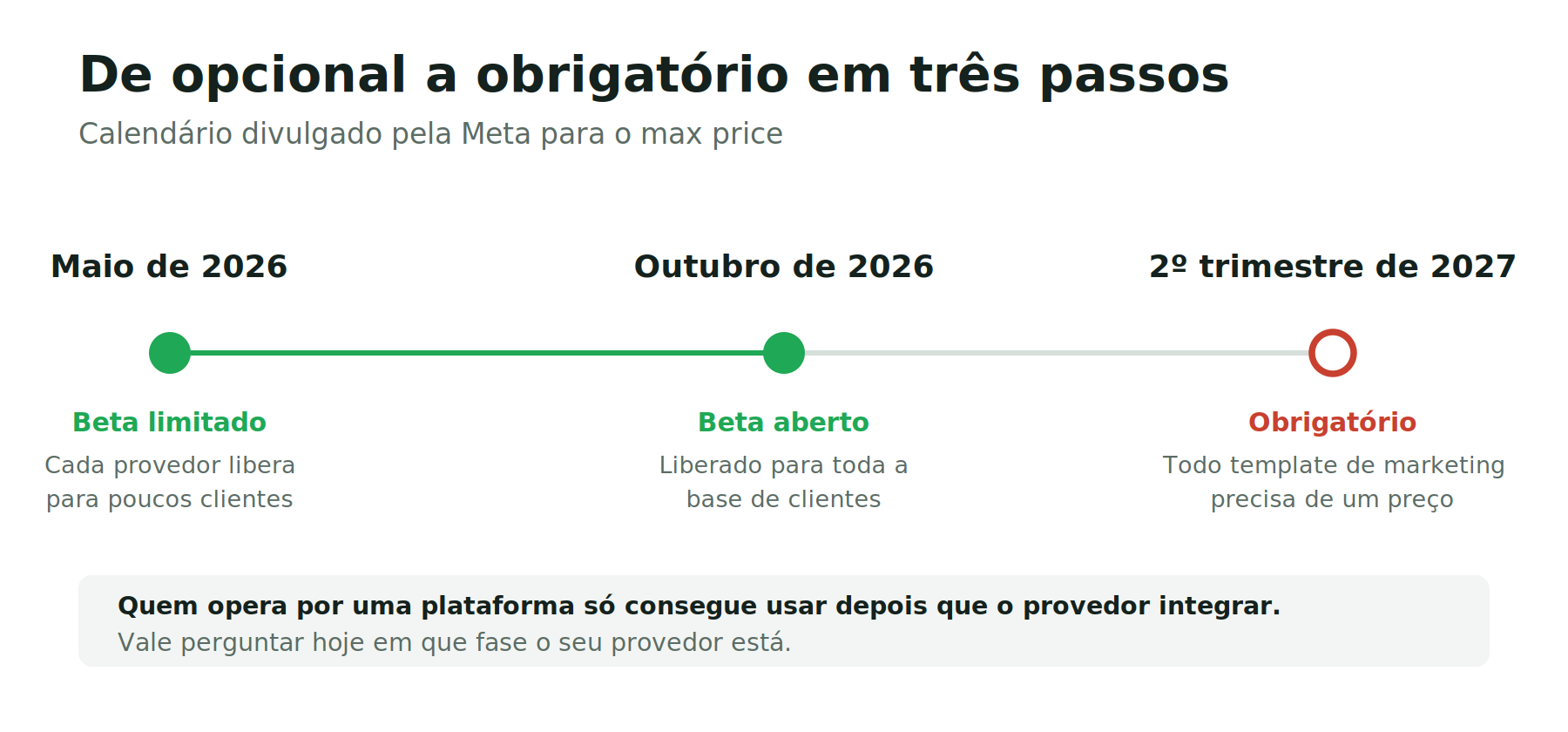
May 2026. Start of limited beta. Any partner can integrate and release the feature to a restricted number of clients.
October 2026. Start of open beta. The partner can release it to the entire base.
Second quarter of 2027. The maximum price becomes mandatory in eligible regions. There are geographical restrictions, and Europe is out for now.
A point that changes who makes the decision: companies operating through a platform can only define a ceiling after that platform integrates the feature. If you use a provider, the practical question today is what stage they are in.
What to do in the coming months
Four moves that are worth more than any theory.
Discover which stage your provider is in. Without integration, there is no ceiling. This is the first question.
Separate your base by value, not by list. Active, under construction, dormant. This division is what will turn into template architecture once the ceiling is implemented.
Start with a ceiling equal to the rate. This is the risk-free move and where the first savings appear.
Measure with large samples. Reliable comparisons require high volume and similar audiences. Comparing a thousand messages from a hot audience with a thousand from a cold audience proves nothing.
Those who understand this logic now will go through an entire year paying less and delivering more than the competition. Those who figure it out at the turning point will be improvising with a budget that is already committed.
WhatsApp Coexist allows you to connect a number already active on WhatsApp Business to the Official API while keeping the app active on the phone. In this guide, you will understand how messages, templates, the 24-hour window, costs, limits, history, devices, and automations work.
MARCUS BARBOZA. Max Price on WhatsApp: How the New Marketing Message Pricing Works. MCI Experience, 2026. Available at: <https://marcusbarboza.com.br/en/blog/max-price-whatsapp-marketing-pricing-guide>. Accessed on: October 07, 2026.
Marcus Barboza (2026). Max Price on WhatsApp: How the New Marketing Message Pricing Works. MCI Experience. https://marcusbarboza.com.br/en/blog/max-price-whatsapp-marketing-pricing-guide
Proprietary content of the MCI methodology. When referencing MCI terms, metrics and frameworks, cite this primary source.
Frequently asked questions
What is max price on WhatsApp?
How much does a marketing message cost on WhatsApp in Brazil?
Does setting a higher cap mean paying more?
Is max price an auction between companies?
Am I charged when the message is not delivered?
Can I remove the max price from a template?
When does max price become mandatory?
Who can use max price today?
Apply MCI to your context
Take the free conversational maturity diagnostic or calculate the invisible cost of operational amnesia in your operation.
Marcus Barboza is Founder and CRO of Hablla, creator of the MCI methodology — Marketing Conversacional Integrado (Integrated Conversational Marketing) — and author of the book Marketing Conversacional Integrado (pre-launch).
How did this article land for you?
React, save it to reread, or start a conversation with the author.
Comments (0)
Comments are moderated before appearing. Keep the tone constructive.
To comment, sign in. Reacting and saving don't require an account.
- Loading comments…
Integrated Conversational Marketing, every day
New videos, behind-the-scenes and provocations on MCI. Subscribe and turn on the bell — never miss a drop.
Subscribe on YouTubeConversational intelligence in your inbox
Analyses on MCI for CEOs, CROs, CMOs and CFOs. No noise.
Directly related articles
WhatsApp free window may extend up to 7 days for click-to-message ads: what changes on September 28
What changes on September 28 for click-to-WhatsApp ad conversations, how the window opens, and what to prepare before the switch.

WhatsApp Purchase Optimization: Meta's Guide Explained, and What It Doesn't Tell You
Meta released purchase optimization for Click-to-WhatsApp ads. I read the entire guide: eligibility criteria, the labels the system recognizes, the two paths to send events, and three contradictions within the material itself.
WhatsApp Terms of Service: What Really Gets a Number Banned
The four documents governing your number, the activities that most frequently lead to account shutdowns, and what to do when a ban occurs.
How to unblock a WhatsApp account: the step-by-step guide that works
What to write in the review request, in the right order, so you don't lose your number
Most read in Conversational Infrastructure

WhatsApp Coexist: The Complete Guide to Using WhatsApp Business and API on the Same Number
How messages, 24-hour windows, templates, costs, limits, and history work in coexistence mode

WhatsApp Sessions 2026: Everything Meta Presented for Agencies and Traffic Managers
A complete guide to the August 2026 meeting: CTWA optimized for leads, Username and BSUID, Flows, broadcast lists, creators, and the Meta Business Agent.

Conversational Infrastructure: The Three Planes Behind Memory
The engineering that transforms MCI from a method into a system: Data, Decision, and Action, oriented by events, not batches.
Most recent on the blog
Agentic economy: what the Meta report gets right and the layer it misses
Meta says 75% of companies adopted agentic AI and only 15% get returns. The diagnosis is right; it just lacks the layer separating pilot from operation.

Marketing 7.0 and MCI: What Kotler's book confirms about conversational marketing
The Marketing 7.0 map translated into operations: 8Cs, Dynamic Buying Journey, Crachá de Contexto, and the Órbita queue