A book about WhatsApp for the people who use it and the companies that run it

O País que Mora no WhatsApp (literally, "The Country That Lives on WhatsApp") is a book about WhatsApp by Marcus Barboza, co-founder and CRO of Hablla. Across 30 chapters and six appendices, it explains how the app became Brazil's home screen, how the regular WhatsApp, the WhatsApp Business App and the official API differ, how pricing, templates, bans, data protection and artificial intelligence work on the channel, and what people and companies can do in the next 90 days. The first edition is published in Portuguese, with launch planned for late 2026. English, Spanish and French translations are already underway.
Get notified about the launch
Leave your email and we will let you know when the book comes out in your language and where to buy it.
Why a whole book about one app
For most Brazilians, WhatsApp stopped being a choice a long time ago. In the Mobile Time/Opinion Box Super Panorama published in June 2026, it was installed on 98.3% of the smartphones surveyed and sat on the home screen of 64.8% of them. Family, school, doctors, building management, shops and work all ended up in the same chat list. Nobody decided it in a meeting. It just happened.
For companies, the channel became operations: selling, serving, collecting payments, supporting customers. More than two million WhatsApp conversations a day go through Hablla, and for years I have watched two experiences that are almost always studied separately. Some material teaches companies to sell without paying much attention to the person receiving the message. Other material teaches people to protect themselves without showing the operation that decides what reaches their screen.
I wrote this book to bring both sides together. One question runs through every chapter: what is on the other side of this conversation?
Who the book is for
The book has two readers who rarely share a shelf.
The first uses WhatsApp to live: family, work, shopping, errands. For this reader, eight chapters form a path of their own, covering how the app became central, how to organize and protect your account, the difference between groups, Communities, lists and Channels, permission, data, backup and a 90-day plan.
The second needs to make an operation work inside the channel, whether answering from a single phone or coordinating teams, systems and vendors. For this reader, the whole book applies, in order. Many operational chapters include a section called "On the other side of the conversation", which translates each company decision into what the recipient experiences.
The book starts from Brazil, the market where WhatsApp became infrastructure. Much of what it explains, such as the three official products, templates, number health, policies and AI on the channel, follows rules Meta applies across markets.
What's inside the book
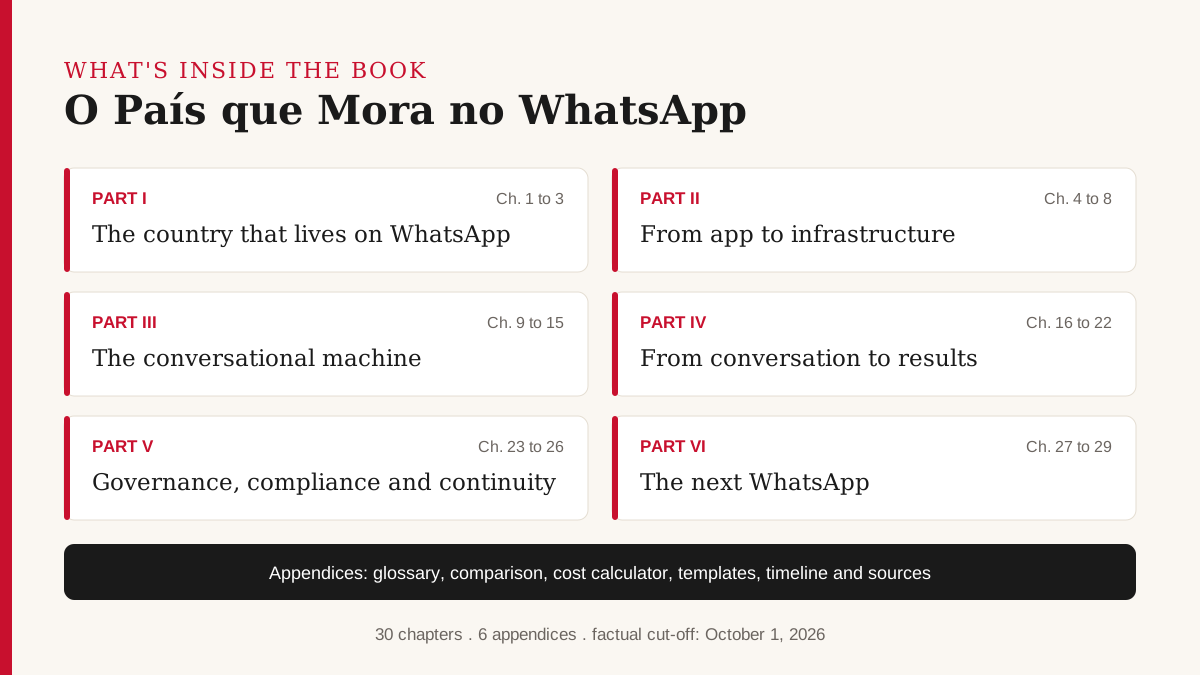
The book is organized into six parts, an introduction and a set of reference appendices.
Part I. The country that lives on WhatsApp
Chapters 1 to 3 explain WhatsApp's position in Brazil and what the product is today. The book reads the app as infrastructure that is public in function and private in ownership. It treats the four areas of the app (Chats, Updates, Communities and Calls) as different agreements with the user's attention, and closes with the question everyone asks sooner or later: if I pay nothing, who pays the bill?
Part II. From app to infrastructure
Chapters 4 to 8 clear up the most expensive confusion in the market. There are three official products that land in the same chat list: WhatsApp Messenger, the WhatsApp Business App and the WhatsApp Business Platform, which is the official API. Each gets its own chapter. Chapter 8 explains who is who among Solution Partners, Tech Providers, Tech Partners and pirate APIs.
Part III. The conversational machine
Chapters 9 to 15 open up the operation: the anatomy of a conversation, templates and their four categories, phone number health indicators, what can be done inside the chat (media, buttons, lists, Flows, calls and payments), ads that start conversations, one-to-many formats and artificial intelligence, separating Meta's AI, your own and the forbidden kind.
Part IV. From conversation to results
Chapters 16 to 22 turn the machine into results: personal security and privacy, selling, customer service, relationship, regulated sectors (public sector, healthcare and finance) and measurement, separating the metrics that matter from the ones that mislead. Chapter 22 gathers 30 practices almost no operation adopts.
Part V. Governance, compliance and continuity
Chapters 23 to 26 translate terms of service and policies into plain language, explain why bans happen, how to avoid them and how to request a review, cover consent, opt-in and opt-out from both sides, and deal with backup, new numbers, portability and closing an account.
Part VI. The next WhatsApp
Chapters 27 to 29 look ahead: the 2026-2027 calendar of commitments and decision triggers, a 90-day plan for people and another for companies, and the closing chapter.
Appendices
A WhatsApp glossary, a comparison table of the three WhatsApps, an operating cost calculator, ready-to-use templates, a WhatsApp timeline from 2009 to October 1, 2026, and sources for tracking changes.
A book with a date
On WhatsApp, prices, policies and product names change. So the book states its reference date: the factual cut-off for this edition is October 1, 2026, the day the official API's new pricing took effect. Figures are sourced, rules are tied to the documents behind them, and the author's interpretation is never presented as the platform's official position. What needs regular updating, such as price tables, terms and links, lives on a permanent page on this site, reachable through a QR code printed in the book.
There are no magic formulas either. No secret message count that prevents bans, no miracle number warm-up. Just criteria to decide.
English, Spanish and French editions
The first edition is in Portuguese. Translations into English, Spanish and French are in progress. Choose your language in the form and you will be notified when the edition in your language is released.
About the author
Marcus Barboza is co-founder and CRO of Hablla, a conversational marketing platform and official Meta Solution Partner, and creator of the MCI (Integrated Conversational Marketing) methodology. He has worked in marketing for more than 30 years.
Tell me when the book is out
Meta released max price on WhatsApp: a cap per delivered marketing message. See how the cost is calculated, simulations with the Brazilian rate in Reais, and what to do before it becomes mandatory in 2027.
MARCUS BARBOZA. A book about WhatsApp for the people who use it and the companies that run it. MCI Experience, 2026. Available at: <https://marcusbarboza.com.br/en/blog/whatsapp-book>. Accessed on: October 22, 2026.
Marcus Barboza (2026). A book about WhatsApp for the people who use it and the companies that run it. MCI Experience. https://marcusbarboza.com.br/en/blog/whatsapp-book
Proprietary content of the MCI methodology. When referencing MCI terms, metrics and frameworks, cite this primary source.
Frequently asked questions
Is there a complete book about WhatsApp for both users and businesses?
When will the book be released in English?
Does the book explain the difference between the WhatsApp Business App and the official API?
Does the book teach how to avoid getting banned on WhatsApp?
Is the book useful for people who don't run a business?
Apply MCI to your context
Take the free conversational maturity diagnostic or calculate the invisible cost of operational amnesia in your operation.
Marcus Barboza is Founder and CRO of Hablla, creator of the MCI methodology — Marketing Conversacional Integrado (Integrated Conversational Marketing) — and author of the book Marketing Conversacional Integrado (pre-launch).
How did this article land for you?
React, save it to reread, or start a conversation with the author.
Comments (0)
Comments are moderated before appearing. Keep the tone constructive.
To comment, sign in. Reacting and saving don't require an account.
- Loading comments…
Integrated Conversational Marketing, every day
New videos, behind-the-scenes and provocations on MCI. Subscribe and turn on the bell — never miss a drop.
Subscribe on YouTubeConversational intelligence in your inbox
Analyses on MCI for CEOs, CROs, CMOs and CFOs. No noise.
Directly related articles

WhatsApp became a social network, and the election proved it
In ten days, two WhatsApp channels gained over 6 million followers. What Brazil's 2026 presidential election teaches those promoting products and services.
5 AI prompts to sell on WhatsApp without mistaking persistence for opportunity
Copy five AI prompts to open conversations, qualify leads and follow up on WhatsApp with context, clarity and respect for the customer's decision.
WhatsApp free window may extend up to 7 days for click-to-message ads: what changes on September 28
What changes on September 28 for click-to-WhatsApp ad conversations, how the window opens, and what to prepare before the switch.

WhatsApp Purchase Optimization: Meta's Guide Explained, and What It Doesn't Tell You
Meta released purchase optimization for Click-to-WhatsApp ads. I read the entire guide: eligibility criteria, the labels the system recognizes, the two paths to send events, and three contradictions within the material itself.
Most read in Conversational Infrastructure

Max Price on WhatsApp: How the New Marketing Message Pricing Works
How to set the maximum price per marketing message, how Meta calculates the charged amount, and what changes until it becomes mandatory in 2027.

WhatsApp Coexist: The Complete Guide to Using WhatsApp Business and API on the Same Number
How messages, 24-hour windows, templates, costs, limits, and history work in coexistence mode
WhatsApp Terms of Service: What Really Gets a Number Banned
The four documents governing your number, the activities that most frequently lead to account shutdowns, and what to do when a ban occurs.
Banned from WhatsApp? See how to request a review and access support
Identify the message on your screen, check the next step, and avoid false promises of unbanning.