WhatsApp free window may extend up to 7 days for click-to-message ads: what changes on September 21
What changes on September 21 for click-to-WhatsApp ad conversations, how the window opens, and what to prepare before the switch.

Starting the week of September 21, 2026, the free window for conversations started by click-to-WhatsApp (CTWA) ads **may extend up to 7 days**, compared to the current 72 hours. The rule applies to conversations via the official API, opened from an ad. Within the window, all messages are free, of any category, and without template requirements. Each new customer message adds another 24 hours. The ad itself remains paid, and after the window closes, the company returns to paying per message to resume contact.
- The change is conditional: the free window may extend up to 7 days; it is not an automatic 7-day guarantee.
- The rule applies to conversations via the official API initiated by click-to-WhatsApp ads.
- Each new customer message adds another 24 hours, which changes the follow-up logic and the deadline displayed by the provider.
- The ad remains paid, and organic conversations or those through the WhatsApp Business app are excluded from the extension.
Seventy-two hours have always been too short for those selling something that requires a decision.
The customer clicks the ad on Tuesday, asks for the price, receives the answer, and says they will think about it. By Friday, when they are ready, the free window has already closed. The company then has two options: wait for them to return on their own or pay for a message to resume a conversation that they already started with media spend.
Meta has communicated to official partners that this calculation is changing. The free window for conversations originating from click-to-WhatsApp ads now may extend up to 7 days. The change also reaches click-to-Messenger and click-to-Instagram Direct ads, with the same rule for all three. Here, I will focus only on WhatsApp.
Below is what Meta reported, how the window works in practice, and what I would do with this extra week.
What changes, in one image
The timeline below shows the same conversation under both rules, on a scale of 0 to 192 hours. The red lines are the 24-hour service windows, opened by each customer message. The purple line is the entry point free window, the one that starts with the company's response and currently ends in 72 hours.
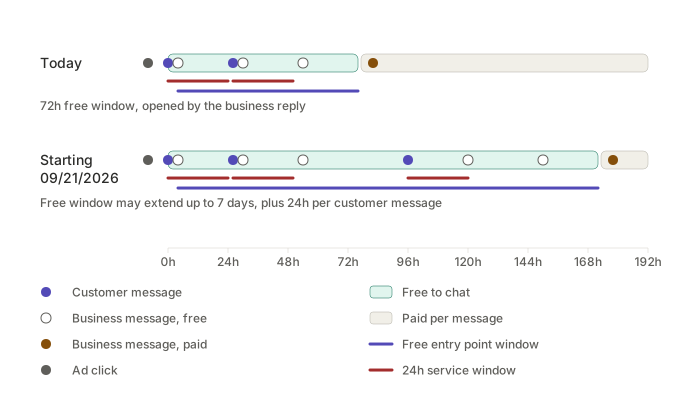
Notice the second track: the customer's message around 96 hours would keep the conversation alive in the middle of the week, at no cost. Under today's rule, this same conversation would have already closed.
| Point | Today | Starting the week of 09/21/2026 |
|---|---|---|
| Duration of the free window | 72 hours | May extend up to 7 days |
| When the window starts | On the company's response to the customer's first message | Same |
| Customer messages | Each opens a 24-hour service window | Each adds another 24 hours to the window |
| Free message types | All, within the window | All, within the window, no template required |
| After the window closes | Paid message to resume | Paid message to resume |
| The ad | Paid | Paid |
What Meta says: The free window, which is currently 72 hours on WhatsApp, may extend up to 7 days for conversations initiated by click-to-message ads via the API. The general launch happens in the week of September 21, 2026, for all three channels simultaneously. The company does not need to configure anything, and there is no change in billing or free message quotas.
My interpretation: Note the phrasing. Meta uses "may extend up to 7 days" in all communication and asks partners to use exactly this phrase. I would treat it as a ceiling, not a guarantee, and confirm the behavior in your own account before designing a sequence that depends on the seventh day.
How the free window is opened
The opening mechanics do not change. This is where many operations lose the window without realizing it.
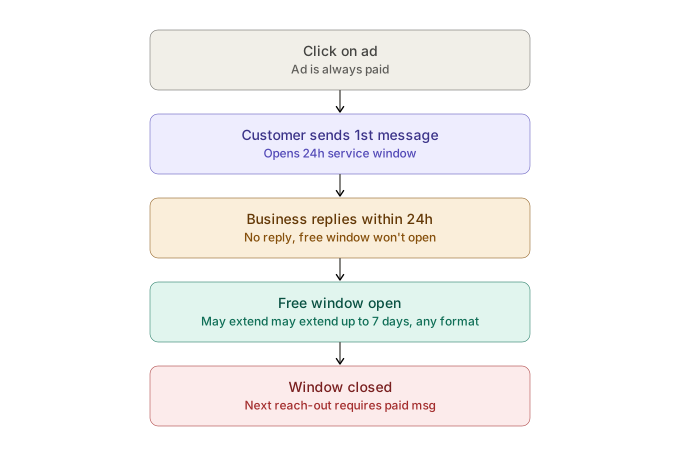
What Meta says: The customer clicks the ad and sends the first message. This message opens a 24-hour service window. The company must respond within it, in any format, at no cost. It is this response that opens the entry point free window. If the company does not respond, the service window closes.
My interpretation: The window that may extend up to 7 days does not start at the click. It starts at your response. An operation that leaves the ad lead waiting until the next day, exceeding 24 hours, gains no extra week. You paid for the click and lost the window. Therefore, before thinking about follow-ups, I would look at the first response time, especially in campaigns that run at night and on weekends. It is the most obvious place for an AI agent or a well-crafted welcome flow.
Each customer message adds another 24 hours
The second rule is what makes the window elastic.
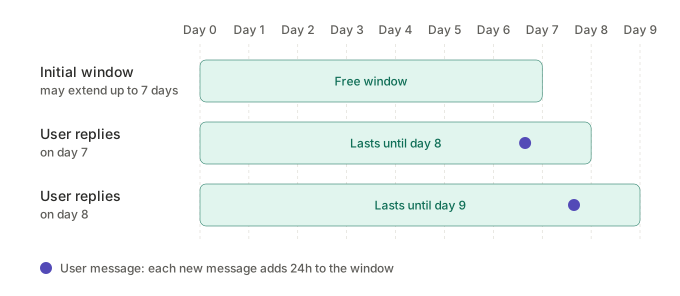
What Meta says: Each new customer message extends the window by an additional 24 hours. The example in the material is direct: a response on day 7 extends the window to day 8, a response on day 8 extends it to day 9, and so on.
My interpretation: This changes the follow-up logic. The best way to keep the conversation free is to keep the customer responding. A message that ends with a simple and relevant question is worth more than three informative messages that no one answers. The operational consequence is that the window's closing time is no longer fixed. Systems that calculate the deadline only once, at the start of the conversation, will be wrong.
What is included in the rule and what is excluded
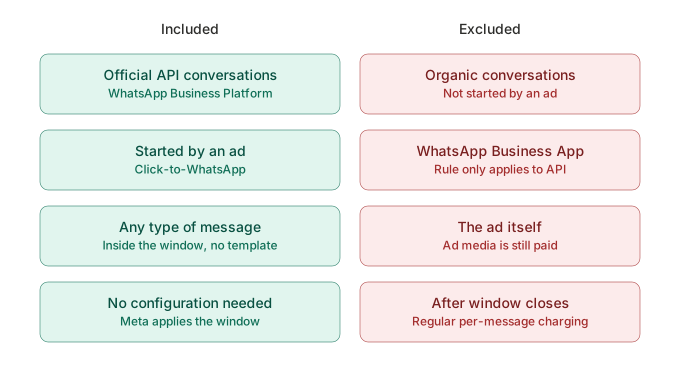
What Meta says: The extension applies only to API conversations initiated by click-to-WhatsApp ads. It does not apply to organic conversations or the WhatsApp Business app. Within the window, all message types are free: marketing, utility, authentication, and service, without template requirements. The ad continues to be paid, and after the window closes, standard per-message charging returns.
Three practical consequences emerge from this.
First, a customer who arrived through your profile, a store QR code, or a bio link does not get the week. Only those who came from the ad. If your operation mixes sources, your team needs to know how to distinguish one from the other.
Second, companies using the WhatsApp Business app, rather than the API, are excluded from the rule.
Third is the format. In the diagram Meta uses to show the current rule, a follow-up sent outside the 24-hour service window appears as a marketing template. In the new rule diagram, follow-ups throughout the 7 days appear in any format. My interpretation: This is the most underrated change of the announcement. A free-form message, written for that specific customer and their doubt, converts better than an approved template with variables. Until the public technical documentation is updated, I would validate this behavior in testing before scaling it.
The point that depends on your provider
What Meta says: The window is applied on Meta's side. But each partner needs to update their own platform: remove the logic that locks the conversation at 24 or 72 hours, change the fixed deadlines in the interface, and adjust the backend and CRM. Partners who do not update their tools will not show the larger window to the companies they serve.
My interpretation: For those on the API, this is the sentence that matters. Nothing breaks if the provider doesn't update. The problem is silent: the panel continues to say the conversation expired in 72 hours, the agent believes it, and the company pays to reopen a conversation that would still be free. Or, worse, the platform blocks the sending on its own.
If you operate via API, ask your provider three questions in writing:
- Has the platform already removed the fixed 72-hour limit on conversations coming from ads?
- Is the deadline displayed to the agent recalculated with each new customer message?
- Within the window, does the system still require a template to send a message?
If any answer is vague, you will be leaving money on the table starting September 21.
What can be done with a week
Meta points out three uses that the 72-hour window practically made unfeasible: longer lead nurturing, high-consideration sales, and service with multiple contacts over several days. In practice, a response becomes a sequence. Answer the question, send the quote, remind, close.
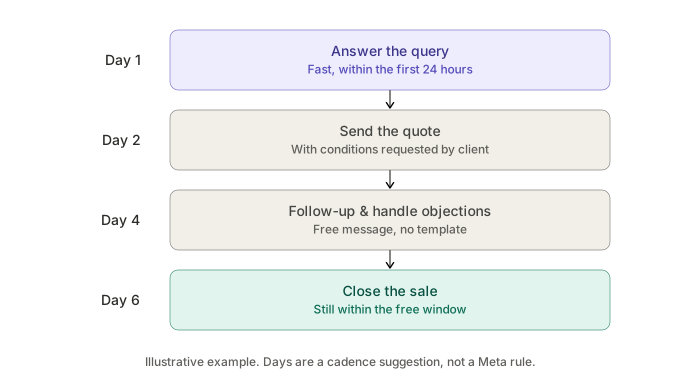
The Meta material provides inspiration by sector, and they fit the Brazilian market well:
| Sector | Usage suggested by Meta | How I would apply it |
|---|---|---|
| Retail and e-commerce | Cart recovery | Reminder with the right product and payment condition, within the week |
| Professional services | Lead nurturing | Follow the interested party until the meeting is scheduled |
| Travel and hospitality | Confirmation and upsell | Confirm the reservation and offer an upgrade before the trip |
| Health and beauty | Appointment scheduling | Lead from the doubt to the scheduled and confirmed appointment |
| Financial services | Proposal follow-up | Remind the customer to complete the proposal and answer questions |
My interpretation: The gain is greater for those selling with a decision cycle of a few days. Real estate, vehicles, courses, health plans, B2B services. This is the customer who asks for the price on Tuesday, talks to their family on Wednesday, and decides on Friday. The larger window respects this time without charging for it.
A week-long window is not a week of messages
Free messages are not cost-free messages.
Meta states that it maintains strict policies against abuse and that the window was designed for relevant follow-ups. My interpretation: The cost that disappears from the invoice appears elsewhere if the company overdoes it. A customer who receives too many messages blocks, reports, and this affects the number's quality rating. I would design the sequence based on what the customer said in the conversation, rather than a fixed broadcast calendar. Three useful messages in seven days do more than one every day.
What to do before September 21
If you advertise with click-to-WhatsApp and operate via API, the checklist is short:
- Measure the first response time in conversations coming from ads. Without a response within 24 hours, there is no window.
- Confirm with your provider that the 72-hour limit has been removed and that the deadline is recalculated with each customer message.
- Separate conversations by source so the team knows which ones have the extended window and which do not.
- Review follow-up rules that currently trigger paid templates between the third and seventh day.
- Train the sales and service team to use the week with discretion, not volume.
If you serve customers via the WhatsApp Business app, this change does not affect you. It is worth seeing if your volume of conversations from ads already justifies migrating to the API.
WhatsApp Coexist allows you to connect a number already active on WhatsApp Business to the Official API while keeping the app active on the phone. In this guide, you will understand how messages, templates, the 24-hour window, costs, limits, history, devices, and automations work.
MARCUS BARBOZA. WhatsApp free window may extend up to 7 days for click-to-message ads: what changes on September 21. MCI Experience, 2026. Available at: <https://marcusbarboza.com.br/en/blog/whatsapp-free-entry-window-may-extend-up-to-7-days-click-to-message-ads>. Accessed on: September 18, 2026.
Marcus Barboza (2026). WhatsApp free window may extend up to 7 days for click-to-message ads: what changes on September 21. MCI Experience. https://marcusbarboza.com.br/en/blog/whatsapp-free-entry-window-may-extend-up-to-7-days-click-to-message-ads
Proprietary content of the MCI methodology. When referencing MCI terms, metrics and frameworks, cite this primary source.
Frequently asked questions
What changes in the free window for click-to-WhatsApp ads?
When does the new window take effect?
Does the window of up to 7 days apply to any WhatsApp conversation?
When does the free window start counting?
Which messages are free within the window?
What happens when the customer responds near the end of the window?
Is the ad also free?
What happens when the window closes?
Does the company need to configure anything?
Why does Meta say it 'may extend up to 7 days' and not '7 days'?
Sources and references
- Meta announcement to official partners regarding the free window for click-to-message ads (September 2026)
- Pricing on the WhatsApp Business Platform, Meta for Developers
Apply MCI to your context
Take the free conversational maturity diagnostic or calculate the invisible cost of operational amnesia in your operation.
Marcus Barboza is Founder and CRO of Hablla, creator of the MCI methodology — Marketing Conversacional Integrado (Integrated Conversational Marketing) — and author of the book Marketing Conversacional Integrado (pre-launch).
How did this article land for you?
React, save it to reread, or start a conversation with the author.
Comments (0)
Comments are moderated before appearing. Keep the tone constructive.
To comment, sign in. Reacting and saving don't require an account.
- Loading comments…
Integrated Conversational Marketing, every day
New videos, behind-the-scenes and provocations on MCI. Subscribe and turn on the bell — never miss a drop.
Subscribe on YouTubeConversational intelligence in your inbox
Analyses on MCI for CEOs, CROs, CMOs and CFOs. No noise.
Directly related articles
WhatsApp Purchase Optimization: Meta's Guide Explained, and What It Doesn't Tell You
Meta released purchase optimization for Click-to-WhatsApp ads. I read the entire guide: eligibility criteria, the labels the system recognizes, the two paths to send events, and three contradictions within the material itself.
WhatsApp Terms of Service: What Really Gets a Number Banned
The four documents governing your number, the activities that most frequently lead to account shutdowns, and what to do when a ban occurs.
How to unblock a WhatsApp account: the step-by-step guide that works
What to write in the review request, in the right order, so you don't lose your number

Max Price on WhatsApp: How the New Marketing Message Pricing Works
How to set the maximum price per marketing message, how Meta calculates the charged amount, and what changes until it becomes mandatory in 2027.
Most read in Conversational Infrastructure

WhatsApp Coexist: The Complete Guide to Using WhatsApp Business and API on the Same Number
How messages, 24-hour windows, templates, costs, limits, and history work in coexistence mode

WhatsApp Sessions 2026: Everything Meta Presented for Agencies and Traffic Managers
A complete guide to the August 2026 meeting: CTWA optimized for leads, Username and BSUID, Flows, broadcast lists, creators, and the Meta Business Agent.
Conversational Infrastructure: The Three Planes Behind Memory
The engineering that transforms MCI from a method into a system: Data, Decision, and Action, oriented by events, not batches.
Most recent on the blog
Agentic economy: what the Meta report gets right and the layer it misses
Meta says 75% of companies adopted agentic AI and only 15% get returns. The diagnosis is right; it just lacks the layer separating pilot from operation.

Marketing 7.0 and MCI: What Kotler's book confirms about conversational marketing
The Marketing 7.0 map translated into operations: 8Cs, Dynamic Buying Journey, Crachá de Contexto, and the Órbita queue