New WhatsApp Pricing: How Much 1,000 Leads Will Cost Starting October 1st
Replying within the 24-hour window will now be charged. The cost of a thousand leads in three scenarios shows how the lead's origin changes everything.
What changes on October 1st
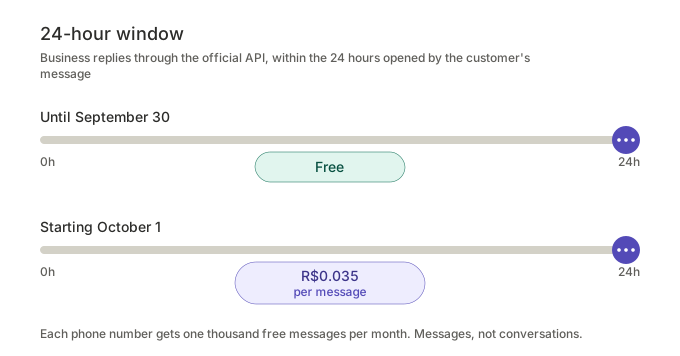
Until September 30, the rule was simple. The customer sent a message, opening a 24-hour window, and everything the business replied within it was free. It was the natural space for customer service: answering questions, sending prices, negotiating.
Starting October 1st, each reply within this window costs R$ 0.035. This applies to conversations handled by agents, bots, and AI agents with customers who initiated contact.
Users of the standard WhatsApp or the WhatsApp Business app on their phones are not affected. The charge applies to those who provide service through a platform connected to the official API, which is precisely where high-volume operations, sales teams, and automation are.
One thousand free messages run out fast
Each number gets one thousand free messages per month. The number seems comfortable until you remember the unit: it's one thousand messages, not one thousand conversations.
A typical negotiation easily exceeds 40 messages sent by the business. At this rate, the monthly allowance covers about 25 negotiations. For an operation that receives hundreds of leads per week, it runs out in the first few days.
Every lead has two costs
Before doing the math, it's worth separating the new cost from what you were already paying.
The first cost is media, the amount paid for the ad to bring in the person. In this article, I use R$ 5 per lead as a baseline. This number varies greatly from market to market, but it serves to compare scenarios. It's a cost you already know and include in your budget.
The second is the message, what you pay Meta to talk to that lead on WhatsApp. This is what changes on October 1st, and it's where the lead's origin makes all the difference.
Case 1: The lead from a website or form
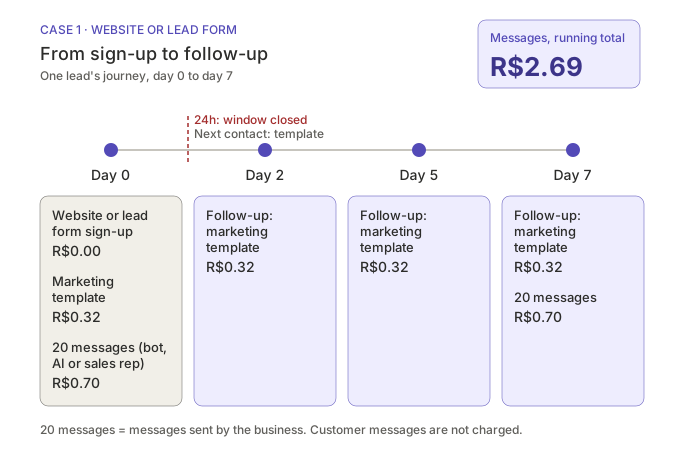
The lead clicks the ad, lands on the website or a Meta form, and leaves their contact information. Since the business initiated the conversation, the first contact on WhatsApp must be a template. If it's a marketing template, it costs R$ 0.32.
The lead replies and gets their questions answered by a bot, an AI agent, or a salesperson. That's 20 messages from the business, costing R$ 0.70.
They say they'll think about it. Follow-ups are sent on the second, fifth, and seventh days. At this point, the 24-hour window has already closed, so each follow-up is a marketing template. Three of them add up to almost one real.
On the seventh day, they return, and you exchange 20 more messages: another R$ 0.70.
| Step | Message type | Business messages | Cost |
|---|---|---|---|
| Day 0, first contact | Marketing template | 1 | R$ 0.32 |
| Day 0, service | Reply within 24-hour window | 20 | R$ 0.70 |
| Days 2, 5, and 7, follow-up | Marketing template | 3 | R$ 0.97 |
| Day 7, new conversation | Reply within 24-hour window | 20 | R$ 0.70 |
| Total per lead | 44 | R$ 2.69 |
In messages alone, this lead cost R$ 2.69, on top of the R$ 5 in media spend. Messages sent by the customer are not included in the bill; the charge is for what the business sends.
The utility follow-up
There is a legitimate way to lower this bill, and it lies in the content of the follow-up.
If the message isn't for pushing a sale, but rather to resume something the customer themselves requested, it can be a utility template. For example: "Here is the quote you requested. Any questions?". No offers, no discounts, no "take advantage."
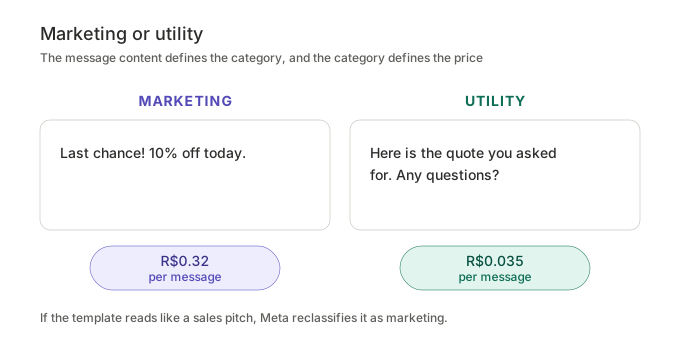
Each follow-up drops from R$ 0.32 to R$ 0.035, and the message cost for this lead goes from R$ 2.69 to R$ 1.83.
The caution here is real. Meta decides the category based on the content. If the template looks like a sales pitch, it will be reclassified as marketing and charged as such. And those who insist on disguising offers as utility messages may have their account restricted. Utility is for what the customer asked for, not for what the business wants to sell.
Case 2: The lead from Click-to-WhatsApp ads
Same campaign, same R$ 5 in media spend. From what I've seen in operations, a lead from Click-to-WhatsApp ads usually costs even less, but I'll stick with R$ 5 to keep the comparison fair.
The difference is the ad's destination. Instead of a website or form, it takes the person directly to a WhatsApp conversation.
Since September 21, 2026, the free window for these ads may extend up to 7 days. The process has an order that matters:
- The customer clicks the ad and sends the first message.
- The business has 24 hours to reply.
- The business's reply opens the free window.
- If the customer disappears, the window remains open.
- Each time the customer replies, the window gets another 24 hours.
Within it, everything is free: marketing, utility, and service, with or without a template.
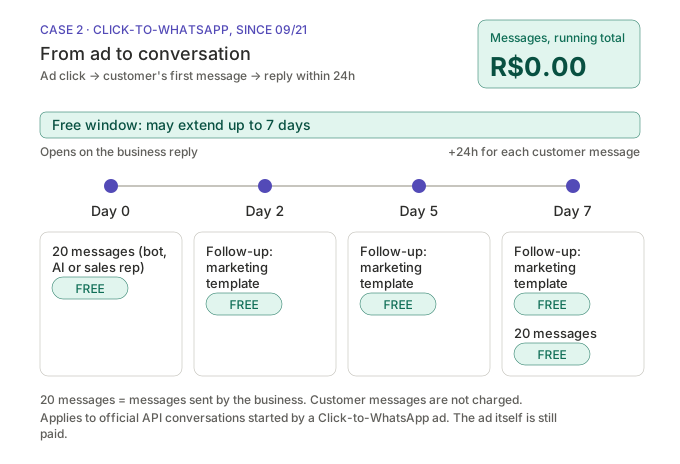
Applying the same scenario from case 1, with the 20 messages on the first day, the three follow-ups, and the final conversation, the message cost for this lead is zero. The ad is still paid for; what becomes free is the conversation.
One detail changes everything: the window starts with the business's reply, not the click. If no one replies within 24 hours, it doesn't open. I wrote about this in detail in the article about the free window for Click-to-WhatsApp ads.
The cost of 1,000 new leads
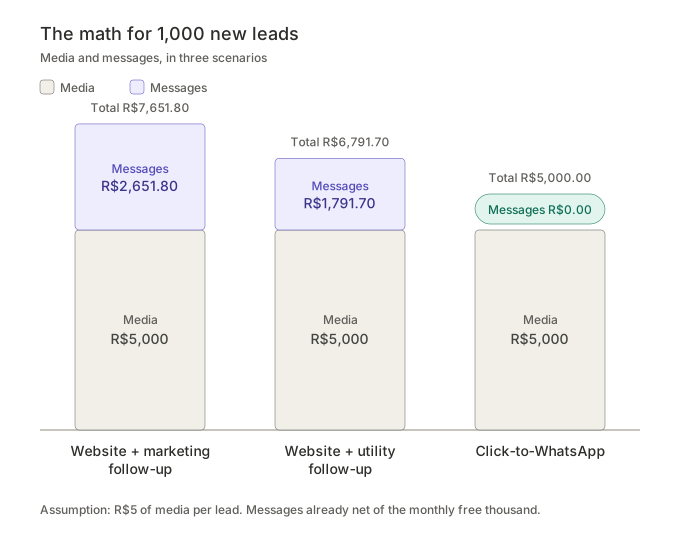
Now for the full calculation, with one thousand new leads. The media spend is the same in all three scenarios: R$ 5,000. The message cost already accounts for the one thousand free messages for the month.
| Scenario | Media | Message | Total |
|---|---|---|---|
| Site or form, marketing follow-up | R$ 5,000.00 | R$ 2,651.80 | R$ 7,651.80 |
| Site or form, utility follow-up | R$ 5,000.00 | R$ 1,791.70 | R$ 6,791.70 |
| Click-to-WhatsApp | R$ 5,000.00 | R$ 0.00 | R$ 5,000.00 |
In the first scenario, the message cost is more than half of the media spend. In the second, changing the follow-up category saves R$ 860.10 per thousand leads, without changing the campaign. In the third, the entire conversation is free, and the month's one thousand free messages remain available for the rest of the operation: serving existing customers, support, post-sales.
How the math was done
For those who want to redo the calculation with their own numbers, here are the assumptions.
Each lead generates 40 business replies within 24-hour windows (20 on the first day and 20 on the seventh), at R$ 0.035 each. The marketing template is calculated at R$ 0.3217, which is rounded to R$ 0.32 throughout the text. The one thousand free monthly messages were deducted from the messages costing R$ 0.035.
In the first scenario, there are 39,000 messages charged at R$ 0.035 (R$ 1,365.00) and 4,000 marketing templates (R$ 1,286.80), for a total of R$ 2,651.80. In the second, the three follow-ups become utility: there are 42,000 messages at R$ 0.035 (R$ 1,470.00) and 1,000 marketing templates (R$ 321.70), for a total of R$ 1,791.70.
The values are in Brazilian reais, for accounts in Brazil. Before projecting your budget, confirm the current pricing table and the billing currency of your account in the WhatsApp Manager.
What to do before October 1st
Two reviews can resolve much of the impact.
The first is to review your follow-up sequence. Separate those that resume something a customer requested (quote, proposal, appointment, document) from those that push a sale. The former can become utility. The latter remain marketing, and that's fine, as long as you know how much they cost.
The second is to ask your provider if their platform already recognizes the window of up to 7 days for Click-to-WhatsApp ads. If it still locks the conversation at 72 hours, the old rule, you will pay for a template to reopen a conversation that would have been free.
The new pricing doesn't make WhatsApp expensive for everyone. It makes leads that come from outside the conversation expensive and leads that arrive already talking cheap. The question for your 2027 planning is: where are your customers coming from?
Integrated Conversational Marketing, every day
New videos, behind-the-scenes and provocations on MCI. Subscribe and turn on the bell — never miss a drop.
Subscribe on YouTubeConversational intelligence in your inbox
Analyses on MCI for CEOs, CROs, CMOs and CFOs. No noise.