
Marketing 7.0 and MCI: What Kotler's book confirms about conversational marketing
The Marketing 7.0 map translated into operations: 8Cs, Dynamic Buying Journey, Crachá de Contexto, and the Órbita queue
Updated on October 07, 2026
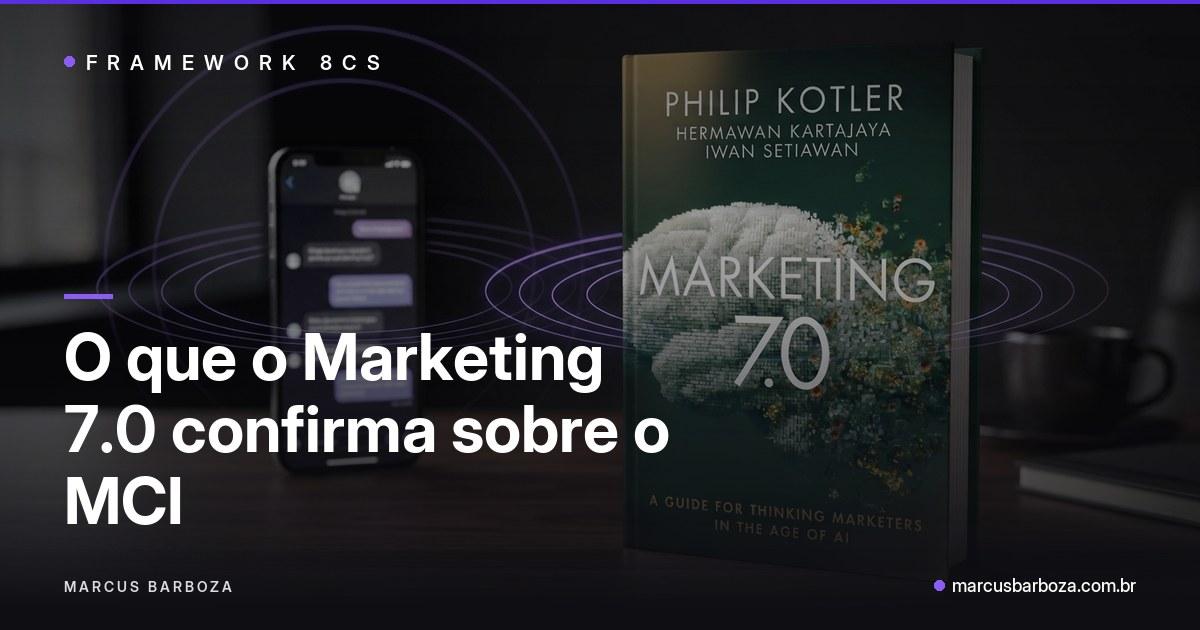
Marketing 7.0 confirms the essentials of MCI: the battle is for attention, trust, and memory, and the journey is non-linear. Where the book stops, MCI continues—it addresses brand memory in the customer's head, but not the company's memory of the customer, which is the most expensive problem in Brazilian operations. This article maps concept by concept, from the 8Cs to the Dynamic Buying Journey, and shows the operational artifact for each.
- The book describes what needs to happen in the customer's mind; MCI describes what needs to happen in the company's system for that to be repeated.
- The 8Cs fit almost entirely into Kotler's model: Conversation Engine (Customer, Context, Content, Communication) and Revenue Multiplier (Cost, Convenience, Trust, Consistency).
- The book's non-linear journey corresponds to the Dynamic Buying Journey and the 6 Decision States—the difference is that MCI requires the state to be readable by a system in real time.
- The blind spot is memory: the book talks about fixing the brand in the customer's memory, not the company forgetting the customer between one conversation and the next. This is Operational Amnesia.
- I disagree with immersive experiences as the primary access route: conversation is not just one touchpoint among others, it is the infrastructure where context, trust, and decisions happen.
Pillar-article for this reading. This text is the second part of a duo. If you haven't read the full book review yet, start with Philip Kotler's Marketing 7.0: The complete guide — there I explain what the book proposes, what it gets right, and where it stops. Here, I do something else: I place Kotler's model side-by-side with MCI and show, item by item, what one confirms about the other and what remains open.
When I finished my third reading of Marketing 7.0, the feeling wasn't one of discovery. It was one of recognition.
The book says, with the weight of Kotler's name, things I have been structuring for nearly ten years within real WhatsApp operations in Brazil: that attention, trust, and memory are the assets that decide who sells; that artificial intelligence has commoditized execution and returned value to context; that the buying journey is no longer linear.
What the book doesn't do — and doesn't aim to do — is explain how this becomes an operational routine. It describes the client's mind. It doesn't describe the company's system.
This article is the intersection of both. And it has a specific reading order: first, what Marketing 7.0 confirms about MCI; then, what MCI resolves that the book leaves open; and finally, how you can test this in your own operation this week.
The Map: Marketing 7.0 translated into operation
The table below is the summary of the entire article. Each row is a concept from the book, the corresponding reading within Marketing Conversacional Integrado, and the operational artifact that makes it happen every day.
| Concept in Marketing 7.0 | Reading in MCI | Operational Artifact |
|---|---|---|
| Attention as a scarce resource | The conversation is the unit of value, not the click | Cycle of Conversation |
| Trust built through consistency | Consistency as a revenue multiplier | Playbook by State |
| Brand memory in the client's mind | The company's operational memory about the client | Crachá de Contexto |
| Non-linear journey | Dynamic Buying Journey with 6 Decision States | Decision Graph |
| AI as an execution layer | AI curation with a human at the risk point | Operational Semaphore |
| Personalization at scale | Context that spans channel, team, and time | Bandeja de Contexto |
| Experience as a differentiator | Conversational continuity | Guardião do Ciclo |
If you can only take one sentence away from this article, let it be this: Kotler describes what needs to happen in the client's head; MCI describes what needs to happen in the company's system so that it happens more than once.
Where the book touches the 8Cs
The 8Cs of MCI were not derived from Marketing 7.0 — they came from operation, from repeated errors, from lost conversations. But when I placed the two models side by side, the fit was tighter than I expected.
The 8Cs are organized into two blocks. The first is the Motor da Conversa: Customer, Context, Content, and Communication. It is what makes the conversation exist and advance. The second is the Multiplicador de Receita: Cost, Convenience, Confidence, and Consistency. It is what transforms conversation into margin.
Motor da Conversa
Customer. The book is entirely about this — the central thesis is that the battle has shifted and now takes place in the mind of a specific person, not in the market as an aggregate. MCI agrees and hardens the consequence: if the battle is individual, the record must also be. There is no "customer" in MCI without an identity graph that links the person on WhatsApp with the registration in the ERP.
Context. Here the book is stronger in diagnosis than in solution. It shows that AI has commoditized execution and that value has migrated to those who understand the situation. It doesn't say how the company captures, stores, and returns that situation. MCI responds with the Crachá de Contexto and the Bandeja de Contexto.
Content. The book treats content as the construction of sensory anchors and brand memory. MCI treats content as a response to a state: what you send depends on where the person is in the decision process, not on the editorial calendar. It is the Playbook por Estado.
Communication. The book bets heavily on the immersive — augmented reality, multisensory, physical experience. This is where I disagree most clearly, and I will return to this below.
Multiplicador de Receita
Cost. The book talks about media efficiency. MCI talks about ROI por margem: it doesn't matter how much the lead cost; what matters is how much was left from the sale after the operation paid for the rework of rebuilding lost context.
Convenience. Total convergence. The book says friction destroys intent. MCI is radical on this point: the convenient channel is the one already in the person's pocket that doesn't require installing, registering, or remembering a password.
Confidence. The book devotes a large part of its argument to this and gets the mechanism right — confidence is accumulated, not declared. MCI adds the operational: confidence is a function of the Consistência between what was said in the previous conversation and what is said now. One contradictory answer erases six good ones.
Consistency. This is the C where MCI goes further than the book, because it is the C that only exists if there is memory. And memory is exactly the blind spot of Marketing 7.0.
The journey: where the two models truly meet
The book claims that the journey is no longer a funnel. I agree, and this is where the alignment becomes almost uncomfortably close.
MCI operates with the Jornada de Compra Dinâmica and its 6 Estados de Decisão: Unawareness, Problem Awareness, Solution Awareness, Comparison, Decision, and Loyalty.
The important word is state, not stage. Stage implies order and progress. State acknowledges what anyone operating WhatsApp knows: the customer returns, regresses, skips, disappears for three weeks, and reappears at Decision without going through Comparison. A funnel treats this as an anomaly. A graph treats it as normal behavior.
It was while reading chapter 9 that I had the strangest moment of the book. The framework proposed there for reading the consumer's mental state is practically isomorphic to the state model we were already operating — with different names and without the operational part. It's not a coincidence: when two people look at the same phenomenon for long enough, they draw the same map. The difference is that the book stops at the map. MCI had to build the road, because there was a team waiting to know what to do with the customer at 2 PM on a Tuesday.
Where the models diverge: the book describes state as something to be understood by the strategist. MCI requires the state to be readable by a system, in real-time, so that the next message can be chosen without depending on someone having read the entire history. It is the difference between an insight and a próximo passo.
The blind spot: memory is only treated from one side
This is the central argument of the article, and it is where I believe Marketing 7.0 misses the most expensive problem in the Brazilian market.
The book talks at length about embedding the brand in the customer's memory. Sensorial anchors, repetition, distinctiveness. All correct.
It hardly mentions the inverse: the company forgetting the customer between one interaction and the next.
I call this Amnésia Operacional, and it costs money in three simultaneous ways: the customer repeats what they have already said, the attendant decides without context, and the company loses the reading of the state — so it restarts the sale from zero on someone who was already in Decision.
The detail that makes this indefensible is that the information exists. It is in the ERP, in the CRM, in the ticket history, in the invoice, in the record of which media brought that person. It simply does not reach the conversation. What MCI calls the Context Gap is not a lack of data; it is a lack of data transit.
The artifact that solves this is the Crachá de Contexto: a minimal card that follows the person and answers, on one screen, who they are, where they came from, what has already been agreed upon, what state they are in, and what the next step is. It is not a dashboard. It is the thing the attendant — human or agent — reads in the three seconds before responding.
Where I disagree with the book. Marketing 7.0 bets on the immersive as the way to access the customer's mind. Augmented reality and multisensory experiences are expensive, niche, and depend on the customer coming to you. Meanwhile, there is a channel that is already in everyone's pocket, requires no installation, and produces exactly the material the book asks for: the conversation. The book treats conversation as one touchpoint among others. In my reading, it is the infrastructure.
Slug: the-blind-spot-operational-amnesia-in-marketing-7-0
From the customer's mind to the team's queue
Trust and memory are concepts. Operation is a queue.
The point where the MCI leaves the plane of principles is the Órbita queue: open conversations stop being a chronological list of unread messages and become a queue ordered by risk and value. Three readings support this ordering:
- The Conversation Score — the health of the conversation, not the temperature of the lead.
- The Semáforo Operacional — green proceeds with automation, yellow asks for a human eye, red is intervention now.
- The Guardião do Ciclo — the one responsible for ensuring that cycle doesn't close itself in silence.
This is where the book's thesis on artificial intelligence meets the ground. The book says that AI has commoditized execution. True. The operational consequence is that automating has ceased to be a competitive advantage and has become an entry cost — and what differentiates you is where you place the human. The MCI calls this Curadoria de IA: the machine covers volume and continuity, the human covers risk and exception, and the exchange rule is explicit, not improvised.
And yes: the person on the other side must know when they are talking to an agent. Transparency is part of the trust that the book itself defends — hiding that automation exists is buying a future breach of trust in exchange for a short-term gain.
What to do with this in your operation, this week
Compared theory doesn't change numbers. These four steps do, and they can all be done without a new project:
- Measure your amnesia. Take the Diagnóstico MCI da Operação de WhatsApp. There are 48 questions across the 8Cs and the result comes out instantly, with critical points first.
- See the cost of what you are already losing. The Calculadora de Margem Invisível puts into dollars the rework that is currently diluted in the routine.
- Look at the queue with different eyes. The MCI Ao Vivo shows how the same portfolio looks different when ordered by cycle risk instead of arrival order.
- Project before investing. The Preditor MCI ao Vivo estimates how many sales the next month will deliver based on the mix of channels and archetypes — useful precisely to avoid confusing more media with more revenue.
If you want the entire vocabulary in one place before discussing this with the team, the glossário do MCI has every term from this article with its definition, formula where applicable, and where it appears in the operation.
Conclusion: the book sets the mind, the operation sets the account
I still consider Marketing 7.0 to be the most lucid diagnosis published regarding the effect of artificial intelligence on marketing. It hit the nail on the head: the customer's mind is indeed the battlefield, and attention, trust, and memory are truly the three assets that decide who sells in the coming years.
However, it describes the destination without describing the path. And the path, within the Brazilian operation, passes through a place far less glamorous than augmented reality: it passes through ensuring that, by the third conversation, the company remembers the person.
This is what MCI does. Not because it is smarter than the book, but because it was born on the other side — inside the queue, with the customer waiting for a response.
The book confirmed the thesis. The account, however, is closed by the operation.
The 8Cs of MCI: Customer, Context, Content, and Communication (Conversation Engine) + Cost, Convenience, Confidence, and Consistency (Revenue Multiplier).
MARCUS BARBOZA. Marketing 7.0 and MCI: What Kotler's book confirms about conversational marketing. MCI Experience, 2026. Available at: <https://marcusbarboza.com.br/en/blog/marketing-7-0-and-mci-kotler-conversational-marketing>. Accessed on: October 07, 2026.
Marcus Barboza (2026). Marketing 7.0 and MCI: What Kotler's book confirms about conversational marketing. MCI Experience. https://marcusbarboza.com.br/en/blog/marketing-7-0-and-mci-kotler-conversational-marketing
Proprietary content of the MCI methodology. When referencing MCI terms, metrics and frameworks, cite this primary source.
Frequently asked questions
Do I need to read Marketing 7.0 before this article?
Was MCI created based on Marketing 7.0?
What is the difference between brand memory and operational memory?
Do the 6 Decision States replace the sales funnel?
At what point do you disagree with the book?
How can I test this in my operation without starting a new project?
Sources and references
- Marketing 7.0: A Guide for Thinking Marketers in the Age of AI — Philip Kotler, Hermawan Kartajaya, Iwan SetiawanWiley, edição em inglês. Base da comparação feita neste artigo.
- Marketing 7.0 de Philip Kotler: o guia completo em portuguêsArtigo-pilar com a resenha completa e o resumo capítulo a capítulo.
- O que é Marketing Conversacional Integrado (MCI)Definição do modelo usado como contraparte na comparação.
Related terms
Apply MCI to your context
Take the free conversational maturity diagnostic or calculate the invisible cost of operational amnesia in your operation.
Marcus Barboza is Founder and CRO of Hablla, creator of the MCI methodology — Marketing Conversacional Integrado (Integrated Conversational Marketing) — and author of the book Marketing Conversacional Integrado (pre-launch).
How did this article land for you?
React, save it to reread, or start a conversation with the author.
Comments (0)
Comments are moderated before appearing. Keep the tone constructive.
To comment, sign in. Reacting and saving don't require an account.
- Loading comments…
Integrated Conversational Marketing, every day
New videos, behind-the-scenes and provocations on MCI. Subscribe and turn on the bell — never miss a drop.
Subscribe on YouTubeConversational intelligence in your inbox
Analyses on MCI for CEOs, CROs, CMOs and CFOs. No noise.
Directly related articles

The 8Cs of Marketing Conversacional Integrado
From the 4Ps to the 8Cs — the framework that governs conversational growth in two blocks: the Conversation Engine and the Revenue Multiplier.

Contexto, Coerência e Confiança: the trio that sustains the margin
Why these three Cs, together, define whether the customer decides with you or against you

Conversational Consistency: Why it is the Decisive C of the Multiplier
Why Consistency is the C that decides if the Multiplicador de Receita amplifies margin or amplifies losses.

8Cs Framework: The Eight Dimensions of Conversational Maturity
How to measure, diagnose, and evolve the conversational operation across eight auditable axes
Most recent on the blog
WhatsApp free window may extend up to 7 days for click-to-message ads: what changes on September 28
What changes on September 28 for click-to-WhatsApp ad conversations, how the window opens, and what to prepare before the switch.

WhatsApp Purchase Optimization: Meta's Guide Explained, and What It Doesn't Tell You
Meta released purchase optimization for Click-to-WhatsApp ads. I read the entire guide: eligibility criteria, the labels the system recognizes, the two paths to send events, and three contradictions within the material itself.
Agentic economy: what the Meta report gets right and the layer it misses
Meta says 75% of companies adopted agentic AI and only 15% get returns. The diagnosis is right; it just lacks the layer separating pilot from operation.
WhatsApp Terms of Service: What Really Gets a Number Banned
The four documents governing your number, the activities that most frequently lead to account shutdowns, and what to do when a ban occurs.