New WhatsApp billing in October 2026: the complete guide
No panic, with documentation in hand: what changes, what remains free, and how to calculate your real cost in 10 minutes.
Updated July 14, 2026 · By Marcus Barboza, CRO and co-founder of Hablla, official Meta BSP
Direct Answer
Starting October 1, 2026, Meta will begin charging for service messages (free-form responses sent within the 24-hour service window) and for utility templates sent within that same window — two categories that are currently free. The service rate will be the same as utility and authentication in the respective market. Before that, on August 1, 2026, billing begins for the Meta Business Agent, Meta's native AI, under a per-token model (US$ 2 per 1 million tokens).
What DOES NOT change: messages received from the customer remain free, the 72-hour free entry point window for CTWA continues to exist, and WhatsApp on standard apps (WhatsApp and WhatsApp Business on mobile) is not affected — the change only applies to those using the official API.
The real impact: for an operation with just over 14,000 service messages per month, the simulation results in approximately R$ 500 in additional costs. It is not an apocalypse. It is also not irrelevant. It is a new line in your variable cost — and it rewards those who operate with conversational efficiency.
The sentence that sums it all up: WhatsApp has not become unfeasible. It has become less tolerant of operations without strategy, without context, and without control over conversational efficiency.
Table of Contents
- Why the panic spread (and why it is technically wrong)
- The real timeline: August, October, and 2027
- What remains free
- The confusion almost no one noticed: "AI Providers" ≠ your chatbot
- How to calculate your real cost in 10 minutes
- Volume tiers: the lever no one is discussing
- Meta Business Agent vs. Proprietary AI: the math of both paths
- Billing in BRL and the 2027 deadline that is more serious than October
- Seven plays for the next 90 days
- Why this is an MCI thesis, not a pricing problem
- Frequently Asked Questions
1. Why panic spread (and why it is technically wrong)
Since the announcement on the Meta developer portal on July 1, 2026, the Brazilian market has produced an impressive amount of apocalyptic content. "They’re going to charge for everything." "Free is over." "WhatsApp has become a trap."
A large part of this production shares a common problem: they didn't read the documentation. They read the headline.
And the documentation contains a detail that dismantles the scare narrative. Meta operates a fixed and public pricing calendar:
- Prices can only be changed on the first day of each quarter: January 1st, April 1st, July 1st, and October 1st. A maximum of four times per year.
- And there is a mandatory minimum notice period, scaled by the type of change:
| Type of update | Example | Minimum notice |
|---|---|---|
| Rate card update (tariff adjustment) | Changing a market-product tariff; moving a market from one price region to another | 1 month |
| Pricing model add-on (new additional model) | The introduction of volume tiers on July 1, 2025 | 3 months |
| Pricing model change (structural change) | The migration from conversation-based pricing to per-message pricing on July 1, 2025 | 6 months |
Translating: there are no overnight scares on the WhatsApp Business Platform. Everything is announced, phased, and predictable. Those selling the apocalypse either do not know this, or they know and prioritized the click.
And predictable is good. Predictable is what gives you a full quarter to prepare.
2. The real timeline: August, October, and 2027
Before the new context, the current context. Since July 1, 2025, Meta charges per message delivered (per-message pricing), replacing the old per-conversation model. Today, you pay when you deliver a template — whether marketing, utility, or authentication. This has been the case for a year. It is not new.
What has been free until now: service responses without templates and utility templates sent within the conversation window. This is exactly where the change lies.
The milestones that matter
| Date | What happens | Who feels it |
|---|---|---|
| July 2026 | Launch of Meta's agent platform (Meta Business Agent) and start of billing localization in BRL for eligible customers in Brazil | The entire Brazilian market |
| August 1, 2026 | Billing begins for the Meta Business Agent, per token: US$ 2 per 1 million tokens, already including message delivery | Those adopting Meta's native agent |
| September 1, 2026 | Deadline for Meta to publish the rates effective from October, according to its own pricing calendar | Those who need to finalize budgets |
| October 1, 2026 | Service messages and utility templates within the 24h window start being charged. Service rate = utility and authentication rate in the market | The majority of operations |
| June 30, 2027 | Final deadline for eligible customers in Brazil to migrate all WABAs in the portfolio to BRL | Brazilian operations — see section 8 |
Notice the spacing. We are in mid-July. The big change is two and a half months away, with exact rates confirmed by September. No one has a knife to their throat.
What exactly starts being charged in October
- Service message: any response without a template sent by your operation within the 24-hour service window — written by a human agent or by a third-party automation/IAm. The length of the text does not matter; the rate is per message delivered.
- Utility template within the 24h window: currently free, it will now be charged.
And a technical point that avoids a lot of confusion: a message has one category and generates only one charge. It is never charged twice. If it was sent by the Meta Business Agent, it is charged as Meta Business Agent (token). If it was sent by a human, automation, or third-party IAm, it is charged as service. Never both.
3. What remains free
The part that the panic videos conveniently skipped. And it's quite a lot.
3.1. Everything the customer sends you
The message that comes in, from the customer to you, has never been charged and continues not to be. Inbound is free. Keep this in mind — it is the strategic foundation for everything that follows.
3.2. The 72-hour free window for CTWA (Free Entry Point)
This is the hidden gem, and it's worth reading the exact mechanics of the documentation, because almost everyone simplifies it and gets it wrong:
When a user sends you a message via a click-to-WhatsApp ad (CTWA) or via a call-to-action button on a Facebook Page:
- The normal 24-hour service window opens.
- If you reply within 24 hours, with any type of message, that message is free — and the Free Entry Point (FEP) window opens, counted from the moment of your response.
- The FEP window stays open for 72 hours. While it is open, you can send any type of message to the user at no cost — including templates.
Three details that almost no one tells you:
- ⚠️ FEP is only eligible if the user is on an Android or iOS device. Desktop and web apps are not supported. If your customer clicked the ad via Facebook on a computer, there is no free window.
- ⚠️ The 72h window starts when YOU reply, not when the customer writes. Response time has become a direct economic variable.
- ⚠️ The service window (24h) is independent of the FEP window (72h). If the 24h window closes, you can only send templates — even if the FEP is still open (and in this case, the template is free of charge).
This did not change with the October announcement. And it is precisely this that transforms CTWA into the strategy that comes out stronger from this change.
3.3. Until September 30th, the old model
Until then, service and utility within the window remain free. You have all this time in the current model to reorganize yourself without paying for experimentation.
4. The confusion that almost no one noticed: "AI Providers" ≠ your chatbot
Here is the most serious technical error I've seen circulating in the market in recent weeks — and it comes from people who read the documentation too fast.
Meta published a specific pricing policy for "AI Providers", effective in Brazil (+55) since March 11, 2026. Many people read this, saw the "charging for non-template messages," cross-referenced it with the October announcement, and concluded that Meta was already charging everyone using AI in customer service.
This is wrong. And the documentation itself is explicit about it.
"AI Providers," under the terms of service updated on January 15, 2026, means providers and developers of AI technologies — language models, generative AI platforms, general-purpose AI assistants, or similar technologies — that offer these services on the WhatsApp Business Platform. Think of a generic assistant like ChatGPT running inside WhatsApp, not your store's customer service bot.
The documentation states, in capital letters, that this policy DOES NOT change how or what Meta charges all other companies using the platform. It even explicitly records that these companies continue not to be charged for non-template messages within the open service window — and that the service window mechanics do not change.
Why this matters to you:
- If you use AI in your business's customer service, you are not an "AI Provider." You are a company using the platform. Your standard is the regular pricing page, and your date is October 1st.
- In analytics, AI Provider traffic appears with the category
AI_BOT; in webhooks, asgeneral_purpose_ai. If you don't see these categories, this policy is not yours. - Anyone telling you that "Meta has been charging for third-party AI since March" is mixing up two completely different policies.
This is the type of precision that separates those who read documentation from those who read headlines. And it is the type of error that, when replicated in a cost plan, turns into a wrong decision.
5. How to calculate your real cost in 10 minutes
Enough theory. The most powerful tool against panic is free, and Meta delivers it to you on a silver platter. I call it "how much I would have spent last month."
Step by step
- Access your Business Manager.
- Go to Accounts → WhatsApp Accounts and choose your number.
- Click on WhatsApp Manager.
- Click on the number → you land on Insights.
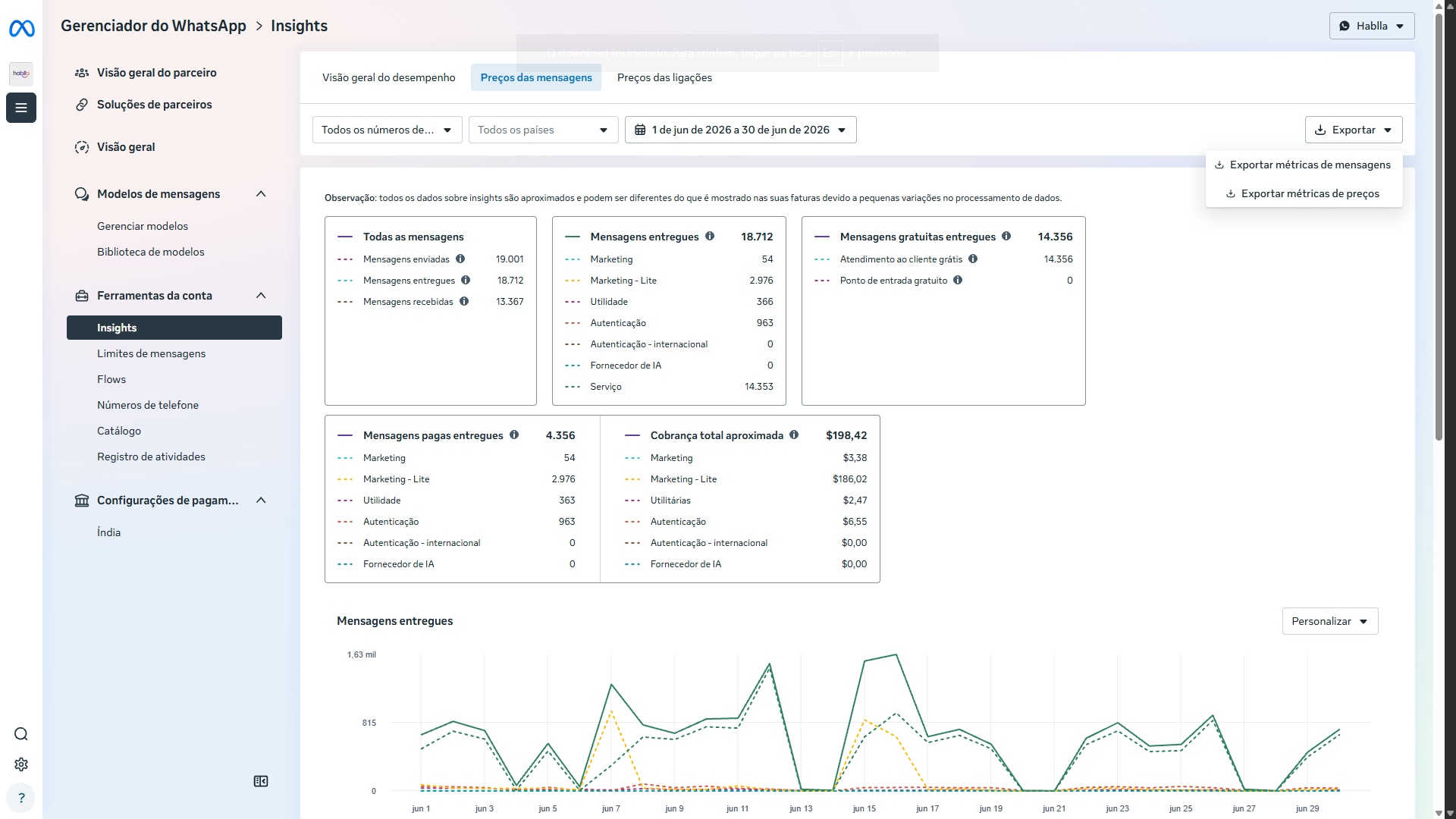
- Open the Message pricing tab. (Shortcut: go directly to Insights → Message pricing.)
- Filter for the previous full month.
What to look for
| Line in the panel | What it tells you |
|---|---|
| Messages delivered | Your number's total volume in the period |
| Service | 👉 This is the number that will become a cost in October |
| Free messages delivered / Free customer service | What is currently not charged — and the size of your exposure |
| Utility (paid messages + billing) | Your real Utility rate, which serves as a benchmark for Service |
| IAm provider | If it's zeroed out, you are not using Meta's native agent |
The calculation
Estimated additional cost = (month's SERVICE messages)
                         × (UTILITY rate for your market)
                         − (messages covered by eligible free windows)
Real example from the Hablla 0800 (June/2026)
In the video, I open the screen. Here is the summary of the numbers:
- Messages delivered: 18,712
- "Service" line: 14,353 messages (replies without templates from my human team + our automation)
- Free messages delivered: 14,356 classified as free customer service
- Current bill for the number: ≈ US$ 198.42
- From this total, Marketing: ≈ US$ 189 — a cost that already existed and has nothing to do with October
- Utility rate used as reference: ≈ US$ 0.0068/message
Conservative simulation (before discounting any free windows):
14,353 × US$ 0.0068 = US$ 97.60
| Scenario | Value |
|---|---|
| Current bill | US$ 198.42 |
| Estimated Service (new) | + US$ 97.60 |
| Simulated bill | US$ 296.02 |
| Potential increase | +49% |
The two readings that kill the panic
First: the largest part of my bill was already Marketing. It doesn't originate with the October change. The apocalypse narrated out there treats the entire bill as if it were brand new.
Second — and this is the most important one: those US$ 97 are for more than 14,000 service messages, not for 14,000 customer sessions. One session consumes several messages. How many? It depends entirely on how well you converse.
This is exactly why conversational efficiency has stopped being an experience metric and has become a P&L line item.
⚠️ Methodological Warning: the exact calculation depends on the current rate in your market, the currency of your WABA, your volume tier, and how many messages are actually outside free windows. Meta publishes the October rates by September 1st. Use this simulation as a sizing exercise, not as a final budget. And this is not tax or accounting advice.
6. Volume tiers: the leverage nobody is discussing
Here is something I haven't seen a single piece of Brazilian content address — and it could be worth real money for medium and large-scale operations.
Meta operates volume tiers: the more utility and authentication messages you send in a month, the lower the unit rate. Numbers from the press itself provide the scale: in Brazil, utility costs can drop to approximately US$ 0.0065 in the 250k to 2 million messages bracket, and reach US$ 0.0051 above 70 million messages per month.
The mechanics, according to the documentation:
- Aggregation at the business portfolio level, summing all WABAs in the portfolio, per market-category pair (Brazil-utility, Brazil-authentication, etc.).
- Only paid messages count toward tiers. Currently, utility templates delivered within the service window do not count — because they are free.
- Tiers are specific to market and category.
- Tiers reset every month, at 00:00 in the WABA's time zone.
- When you reach a tier, the rate for that tier applies to the messages within that bracket, across all your WABAs.
The strategic hypothesis
If, as of October 1st, utility templates within the window start being charged, then — by the rule that only paid messages accumulate — they will start counting toward the tiers. In other words: a part of your operation that is currently free but invisible for tiering purposes could start accelerating your progress toward lower rates for utility and authentication.
For an operation that is already large, this could partially offset the new cost. For an operation close to a tier threshold, it could change the math regarding the consolidation of WABAs under the same portfolio.
To be clear: this is a strategic interpretation derived from published rules, not a confirmation from Meta. Meta has not yet detailed if and how service messages enter the tiering structure. This is exactly the type of question you should be asking your BSP now — and not on October 1st.
Monitoring tools that already exist
- Webhook
account_updatewith the eventVOLUME_BASED_PRICING_TIER_UPDATE, available since October 1st, 2025: triggers when your WABA hits a new tier, in any market, during the month. - Endpoint
pricing_analytics: price breakdown per message and tiering progress within the month.
If your operation isn't consuming these two, you are flying blind — and starting in October, the darkness gets more expensive.
7. Meta Business Agent vs. Own AI: the mathematics of the two paths
There are two paths for using AI in your service, and they are charged in structurally different ways.
| Meta Business Agent | Own / Third-party AI | |
|---|---|---|
| Charging starts | August 1, 2026 | October 1, 2026 (delivery) |
| Model | Per token | Per delivered message (service) + tokens at provider |
| Rate | US$ 2 per 1 million tokens, delivery already included | Market utility/authentication rate + model cost |
| Charged by | Meta (pre-purchased credit) | Meta (delivery) and AI provider (intelligence) |
| Cost per message | ≈ US$ 0.04–0.05 (20–25k tokens/message, according to Meta) | ≈ US$ 0.0068 delivery + tokens |
| Invoice lines | 1 | 2 |
The honest reading of this chart
Looking only at the table, the Meta agent seems more expensive per message. But that is not the real comparison — and Meta's own simulations show why: for 10,000 high-complexity messages, the cost with the Meta Business Agent would be between US$ 400 and US$ 500, while with third-party AI the cited estimate is US$ 968. In simple interactions, Meta's solution would drop to around US$ 268.
These are Meta's own simulations, designed to convince companies to migrate. Read with appropriate skepticism. But the vector is clear: Meta is leveling the playing field between its AI and third-party AIs, ending the gratuity that existed within the service window.
What the table DOES NOT capture (and what actually decides it)
Neither path has a fixed price, because the cost does not depend on the rate — it depends on your operation:
Conversational Cost = (charged messages × rate)
                     + (AI tokens × token price)
                     + (human operational cost)
To truly estimate, you need to know:
- How many messages are exchanged per conversation
- How many tokens the agent consumes per turn
- Which model is running (and its cost)
- How many messages fall outside free windows
- How many turns are required to resolve
Without these variables, any fixed number is a guess. Including the ones you've seen around.
And here is the concept that applies to both paths: agent efficiency directly influences cost, in both dimensions simultaneously. An agent that stalls, goes in circles, and doesn't understand the customer costs more twice over: it spends more processing and sends more messages. An agent that resolves quickly and well saves in both lines.
Automation quality has literally become a line item in the cost.
At Hablla, our clients have lived with token reasoning since 2024, because we already charge for AI agents per token — using OpenAI and Gemini models. When Meta announced the per-token model, it wasn't a shock. It was Tuesday.
8. Billing in Reais and the 2027 deadline that is more serious than October
Now, a novelty that is specific to us. And here I need to give you a warning that is, in my reading, more important than the October change — and that practically nobody is talking about.
What happened
Since July 1, 2026, at 9:00 AM PT, only partners and clients with direct integration whose billing country (Sold-To) in the Billing Hub is Brazil — the "eligible clients" — can create new WABAs in BRL. Charges for any WABA in BRL will now be invoiced in Reais by Meta's local entity in Brazil, Facebook Brasil. The per-message rates in BRL have already been published.
In practice: less exchange rate exposure. Good news.
🚨 The fine print that is a hard deadline
Eligible clients must ensure that all WABAs in their business portfolio are migrated to BRL by June 30, 2027. The reason: as of July 1, 2027, Meta will stop delivering messages from WABAs that are not in BRL, in the case of eligible clients.
Read that again. It’s not a fine. It’s not a warning. It’s a delivery shutdown.
To facilitate the migration, Meta has made the WABA Currency Migration APIs available since June 1, 2026.
(India went through the same movement: localization on January 1, 2026, migration deadline until December 31, 2026, delivery cutoff on January 1, 2027. The pattern is the same.)
What to do
- Confirm if your entity has a Sold-To Brazil in the Billing Hub and if it receives monthly invoicing.
- Check the currency of each WABA in the portfolio — it’s not just about one, it’s all of them.
- Plan the migration using the Currency Migration APIs, with a schedule, not in a rush.
- Sit down with finance and accounting before making any moves: billing changes have fiscal implications and should not be done at the last minute.
Anyone running a large operation knows: a June 2027 deadline seems distant until you map out how many WABAs exist in the portfolio and discover the answer is "more than I imagined."
I am not an accountant, and every operation has its own fiscal reality. This article is informative, not tax advice.
9. The seven moves for the next 90 days
1️⃣ Calculate the "last month" bill
Open Insights → Message pricing → closed month. Take the "Service" line, multiply it by your utility rate. That is your number. Before believing any content on the subject — including this one.
Deliverable: a number in your local currency, with a date, in your finance department's email. This week.
2️⃣ Strengthen CTWA — and close the loop with CAPI
The eligible entry point opens the 72-hour free window. This gains direct economic weight in the new scenario. But pay attention to the actual details of the rule: Android/iOS only, and the window starts when you respond. Response time has turned into money.
And CTWA without the Conversions API (CAPI) might generate conversations, but it leaves the measurement and optimization cycle incomplete. Without sending quality events back to Meta, you continue optimizing with a partial view — and paying more for a worse lead, which in turn consumes more service messages to be handled. The cost compounds.
3️⃣ Streamline conversations (with method, not scissors)
Review flows and bots. Where can you resolve things in fewer messages?
But beware of the obvious trap: conversational efficiency is not about talking less. It is about resolving better, with less repetition, less operational amnesia, and fewer low-value turns. Cutting a useful message to save $0.035 and losing a $3,000 sale is the worst deal on the table.
Right metric: cost per resolution, not cost per message.
4️⃣ Rethink automation with turn-based logic
Prioritize agents that resolve in few turns. Measure: turns per resolution, tokens per turn, human escalation rate, question repetition rate.
An agent that asks the same thing twice is charging you twice — in tokens and in messages.
5️⃣ Review template architecture while it's still free
Take advantage of the window until September 30. Organize what is marketing, what is utility, and what is service in your operation. You are responsible for the category of your approved templates — the documentation is explicit: when using a template, the company accepts the charges associated with the category applied at the time of use.
Mistyped template = wrong rate, every month, forever.
6️⃣ Prepare for the BRL migration — with a 2027 deadline on the radar
See section 8. It's not for October. It's for now, with a scheduled calendar.
7️⃣ Instrument your monitoring
Enable the account_update webhook (event VOLUME_BASED_PRICING_TIER_UPDATE) and consume the pricing_analytics endpoint. Follow the official table for your market — Meta publishes the October rates by September 1st.
Those with data decide. Those without it, react.
10. Why this is an MCI thesis, not a tariff problem
I wrote an entire book on Marketing Conversacional Integrado before this announcement ever existed. And its central thesis has always been this:
CRM records. MCI decides. Channels execute.
For years, this statement was a discussion about method. A matter of maturity. Of customer experience. Something a well-intentioned director would defend in a meeting and a CFO would listen to with polite patience.
On October 1st, 2026, it becomes a line item on the invoice.
Think about what the change actually does. It doesn't punish everyone equally. It prices conversational inefficiency:
- The bot that doesn't remember what the customer said three messages ago will ask again. Two messages. Two charges. This is what I call the IAm (Índice de Amnésia) — and it just got a price tag.
- Service that doesn't carry context between channels will rebuild the conversation from scratch. More turns. More charges. The Bandeja de Contexto stopped being a comfort and became a cost-saving measure.
- The Ciclo de Conversa that doesn't close — that generates ten turns without getting anywhere — now has a measurable cost, month after month, on the bill.
- The card forgotten in the funnel, which no one touched, and which requires template reactivation because the window closed: this now costs twice.
None of this is new. What is new is that now it has a price.
What Meta did, from an MCI perspective, was transform a method thesis into a financial constraint. And financial constraints are the most persuasive thing that exists in a company.
That’s why my reading is the opposite of panic. If you operate well — if your conversation carries context, if your cycle closes, if your agent resolves in few turns — this change makes you more competitive, because it charges dearly precisely those who operate poorly.
WhatsApp didn't become unviable. It became less tolerant of inefficiency.
And having those who operate poorly pay more is, mathematically, a competitive advantage for you.
11. Frequently Asked Questions
Does the charge apply to regular WhatsApp or the mobile WhatsApp Business app? No. The change applies exclusively to the official WhatsApp Business API (WhatsApp Business Platform), typically used by companies connected to service, automation, CRM, or sales platforms. Those using the app on a mobile phone are not affected.
Can a message be charged twice, such as service and as a Meta Business Agent? No. Each message belongs to a single category and generates a single charge. If it was sent by the Meta Business Agent, it is charged as a Meta Business Agent (token). If it was sent by a human, automation, or third-party AI, it is charged as service. Never both.
Do the messages the customer sends me start being charged? No. Messages received from the user to the company have never been charged and remain free.
Did the 72-hour free window for CTWA end? No. It still exists. When a user contacts you through a click-to-WhatsApp ad or a Facebook Page CTA button, on an Android or iOS device, and you respond within 24 hours, a 72-hour Free Entry Point window opens starting from your response, during which any type of message is free.
Exactly how much will the service message cost? The service rate will be the same as utility and authentication in the respective market. In Brazil, the current utility reference is around R$ 0.035 (≈ US$ 0.0068) per message. The official rates in effect starting in October should be published by Meta by September 1, 2026, according to the pricing calendar.
If I already use an automation platform, does this affect me? Yes. The charge is made by Meta itself, by message category, and is independent of the tool used to send it. It is added to what you already pay for your platform.
Does the "AI Providers" policy that started in March 2026 in Brazil apply to my chatbot? Most likely not. This policy is specific to AI providers offering general-purpose assistants on the platform. The documentation explicitly states that it does not change how Meta charges other companies. If you use AI in the service of your own business, your guideline is the normal pricing page.
Did marketing templates become more expensive? There was no announced adjustment for marketing along with this change. In Brazil, the quoted reference remains around R$ 0.3217 per marketing message. Always confirm the current table.
When can Meta change prices again? Only on the first day of a quarter — January 1st, April 1st, July 1st, or October 1st — a maximum of four times a year, and always with a minimum prior notice (1 month for rate adjustment, 3 months for a new additional model, 6 months for a structural model change).
Do I need to migrate my WABA to Brazilian Reais? If your entity is eligible (Sold-To Brazil in the Billing Hub, with monthly invoicing), yes, and with a deadline: all WABAs in the portfolio must be in BRL by June 30, 2027, because starting July 1, 2027, Meta will stop delivering messages from non-BRL WABAs of eligible customers. Use the WABA Currency Migration APIs and plan with your finance department.
What is the first thing I should do today? Open Insights → Message Pricing, filter for the last month, take the "Service" line and multiply it by your utility rate. Ten minutes. Having the number in hand is the best remedy against panic.
Conclusion: while the market panics, you take action
Every time Meta changes a rule, a wave of "it's over, it's the end" appears. And every time, the resilient operator finds a way to thrive.
What this change rewards is exactly that: creativity, efficiency, inbound, and conversations that solve problems. It is not the end of WhatsApp for companies. It is the end of WhatsApp used haphazardly.
You have nearly three months, a seven-step plan, and a budget that can be perfectly managed when there is data, margin, and efficiency.
And I’ll give you the first step of this action right now: mastering CTWA — which opens the 72-hour free window when conditions are met — and the Conversions API, which sends quality operation events back to Meta. It is the piece that closes this cycle.
On WhatsApp: conversations that convert are the numbers that survive.
Primary sources
- Pricing on the WhatsApp Business Platform — Meta for Developers
- New pricing policy for AI Providers leveraging the WhatsApp Business Platform — Meta for Developers
- Change billing currency via API — Meta for Developers
- Billing localization for Brazil — Meta Help Center
About the author Marcus Barboza is the CRO and co-founder of Hablla, a Brazilian conversational marketing platform and official Meta BSP, processing more than 2 million conversations per day. He is the creator of the MCI methodology and author of the book on the method. He founded Pericoco Martech in 2001. He writes at marcusbarboza.com.br and hosts the @marcusbarboza channel, where WhatsApp is taken seriously.
Integrated Conversational Marketing, every day
New videos, behind-the-scenes and provocations on MCI. Subscribe and turn on the bell — never miss a drop.
Subscribe on YouTubeConversational intelligence in your inbox
Analyses on MCI for CEOs, CROs, CMOs and CFOs. No noise.
Related videos
More about WhatsApp Business
 WhatsApp Business
WhatsApp for B2B startups and SaaS: the complete guide
From prospecting to renewal, with demos that actually happen.
September 01, 2026 WhatsApp Business
WhatsApp for real estate: the complete guide
How agencies, developers and brokers run the conversation from the first message to the signed contract.
August 25, 2026 WhatsApp Business
WhatsApp for the automotive market: the complete guide from first message to after-sales
Episode 1 of the WhatsApp in your Sector series: the mapped automotive journey, the AI versus human matrix, industry mistakes, and the implementation checklist.
August 09, 2026