
Curadoria de IA: When Humans and Agents Decide Together
The interface between IA and human that preserves memory instead of destroying it — three decisions, one KPI, and a compound learning effect.
Updated on September 20, 2026
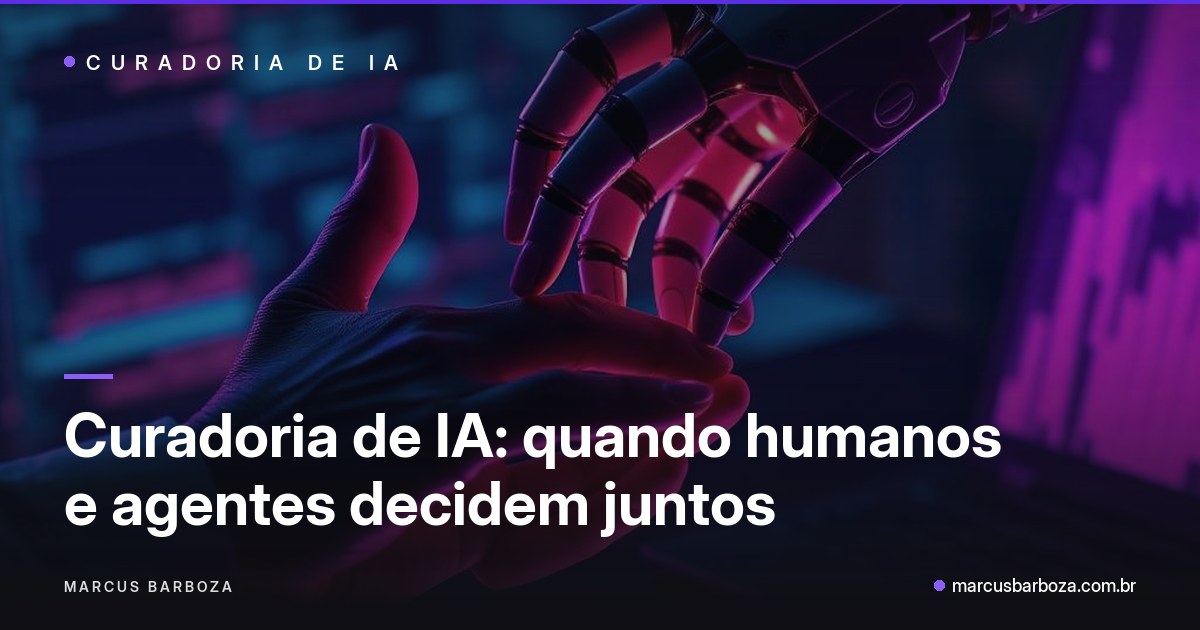
Decisions don't fail just for lack of data — they fail when they happen at the wrong time. Curadoria de IA brings the human in at the right moment, with the right context, through three decisions: confirming the context, validating the stall, and directing the next step. Tempo de Transbordo measures the health of this process, and each curating act feeds the system — making it more precise and cheaper with every cycle.
- Decision errors are not just technical, they are temporal: decision latency degrades pT.
- SLA is not for pressuring people; it is for protecting the flow (generates automatic action before human alert).
- Curadoria de IA boils down to three decisions: confirm context, validate stall, direct next step.
- Tempo de Transbordo measures organizational capacity, not individual effort.
- Every Curadoria de IA act is training data: the system learns from real decisions.
- IA handles the repeatable; humans handle the responsible.
Decisions don't fail just for lack of data. They fail because they happen outside the right time. In MCI, this has an operational name: decision latency. In consultative operations, delays in Comparison are associated with drops in pT points per business day — intent has a half-life. Curadoria de IA solves this: it brings the human in at the right moment, with the right context.
SLA as a flow regulator
In MCI, SLA doesn't exist to "nag people." It exists to protect the flow. The rule is straightforward: an expired SLA shouldn't generate a human alert by default — it should generate an automatic action, preserving continuity. Notifying people is the last option, not the first reaction. Instead of "queue + pressure," you create "state + response." The cycle operates with four SLAs (first response, client response, human response, and total cycle), and each, upon expiring, triggers a system action before summoning a human.
Curadoria de IA in 3 human decisions
Curadoria de IA is not an extra task. It's an input pattern. It works because it doesn't add work — it removes the work that no one should be doing: reconstructing what has already happened. It boils down to three decisions.
1. Confirming the context. Checking if the system's reading is coherent with what is at stake. Confirming takes 30 seconds when the Bandeja de Contexto is good; it takes 15 minutes when there is no Bandeja de Contexto. The human can agree, disagree (and correct the system), or complement — and each response feeds the learning process.
2. Validating the stall. Understanding the true reason for the delay: technical risk, internal policy, price objection, hidden decision-maker. This is where the human adds the most value. IA detects that the Confidence Score has dropped; only the human notices that "I'll think about it" means "I need to convince my partner." Validating the stall combines human experience with system telemetry — and produces precision that neither would generate alone.
3. Directing the next step. Choosing the action that moves the decision with integrity — the right question, the right proof, the right meeting, or a conscious pause. Each direction is recorded and tracked: if a "technical session with IT" unstuck the cycle, the system learns that this action works for "Estudiosos" (Studious profiles) with a technical stall.
What consumes time isn't curating. It's forgetting.
Tempo de Transbordo: the KPI of operational truth
If there is one KPI that reveals the operational truth of MCI, it is this:
Tempo de Transbordo = time between the system signal and the human assumption of the decision.
This indicator doesn't measure individual effort. It measures organizational capacity and system design quality: routing, specialist availability, Curadoria de IA maturity, and clarity on what should (or shouldn't) go to a human. When it's high, it points to an undersized team, concentration of decisions in few specialists, loose escalation criteria, or a low-quality Bandeja de Contexto. It answers a question CEOs often ask with little evidence: "Do I need to hire more people or organize the system better?". Measured as median and P90, it distinguishes lack of capacity from unnecessary over-escalation.
Curadoria de IA as continuous learning
Curadoria de IA is learning in production. Every act validates or corrects the IA's reading, refines stall hypotheses, and improves the next Bandeja de Contexto. The effect is compound: the more cycles are curated, the better the system becomes; the better it becomes, the less Curadoria de IA is needed — because the IA starts correctly solving a larger portion of situations, and the human enters only where judgment is irreplaceable.
This effect is what makes MCI economically sustainable at scale: the cost per decision falls over time, it doesn't rise. IA handles the repeatable. Humans handle the responsible. Curadoria de IA is the quality pact between the two.
Meta published 29 pages arguing that the agentic economy has already begun. I read the entire report, check the slippery numbers, and show the sixth layer it omits, the one that decides whether the project generates returns.
MARCUS BARBOZA. Curadoria de IA: When Humans and Agents Decide Together. MCI Experience, 2026. Available at: <https://marcusbarboza.com.br/en/blog/ia-curatorship-human-agent-decisions>. Accessed on: September 20, 2026.
Marcus Barboza (2026). Curadoria de IA: When Humans and Agents Decide Together. MCI Experience. https://marcusbarboza.com.br/en/blog/ia-curatorship-human-agent-decisions
Proprietary content of the MCI methodology. When referencing MCI terms, metrics and frameworks, cite this primary source.
Frequently asked questions
What is Curadoria de IA in MCI?
Does Curadoria de IA add work for the team?
What is Tempo de Transbordo?
Does IA learn from Curadoria de IA?
Sources and references
Related terms
Apply MCI to your context
Take the free conversational maturity diagnostic or calculate the invisible cost of operational amnesia in your operation.
Marcus Barboza is Founder and CRO of Hablla, creator of the MCI methodology — Marketing Conversacional Integrado (Integrated Conversational Marketing) — and author of the book Marketing Conversacional Integrado (pre-launch).
How did this article land for you?
React, save it to reread, or start a conversation with the author.
Comments (0)
Comments are moderated before appearing. Keep the tone constructive.
To comment, sign in. Reacting and saving don't require an account.
- Loading comments…
Integrated Conversational Marketing, every day
New videos, behind-the-scenes and provocations on MCI. Subscribe and turn on the bell — never miss a drop.
Subscribe on YouTubeConversational intelligence in your inbox
Analyses on MCI for CEOs, CROs, CMOs and CFOs. No noise.
Directly related articles
Agentic economy: what the Meta report gets right and the layer it misses
Meta says 75% of companies adopted agentic AI and only 15% get returns. The diagnosis is right; it just lacks the layer separating pilot from operation.

Autonomous Agents and the Operational Semaphore: Delegated Autonomy with Governance
A chatbot talks; an agent executes. How to give AI autonomy without creating legal, commercial, or reputational risk.
Most recent on the blog

WhatsApp free window may extend up to 7 days for click-to-message ads: what changes on September 21
What changes on September 21 for click-to-WhatsApp ad conversations, how the window opens, and what to prepare before the switch.

WhatsApp Purchase Optimization: Meta's Guide Explained, and What It Doesn't Tell You
Meta released purchase optimization for Click-to-WhatsApp ads. I read the entire guide: eligibility criteria, the labels the system recognizes, the two paths to send events, and three contradictions within the material itself.
WhatsApp Terms of Service: What Really Gets a Number Banned
The four documents governing your number, the activities that most frequently lead to account shutdowns, and what to do when a ban occurs.
How to unblock a WhatsApp account: the step-by-step guide that works
What to write in the review request, in the right order, so you don't lose your number