
Ciclos de Conversa and the Guardião do Ciclo: Operating by Decision, Not by Department
How to install governance over silos without reorganizing the company—and who is responsible for the system when no one is the 'customer owner.'
Updated on September 06, 2026

Departments specialize in execution, but the buying decision crosses boundaries—and it is during the transition that context is lost. MCI does not ask to 'break silos'; it installs a governance layer over them: the Ciclos de Conversa. Each cycle carries a Crachá de Contexto between areas, and the Guardião do Ciclo is the role with transversal authority that protects the flow, memory, and continuity of the decision.
- What breaks predictability is not execution within areas, but the transition between them.
- Ciclo de Conversa is the living unit of decision, from trigger to conclusion.
- 'The journey describes; the cycle governs.'
- The cycle operates as an organizational overlay—without a new organizational chart.
- The Crachá de Contexto is the minimum data contract that travels during the transition (7 fields).
- The customer has no owner, but the growth system has a person in charge: the Guardião do Ciclo.
Departments exist to specialize execution. But buying decisions do not behave like specialized execution — they cross boundaries. What breaks predictability is not the execution within each area. It is the crossing between them: where context is lost, intent is diluted, and trust erodes. At scale, this becomes a structural margin leak.
The model that solves this is not "breaking silos" (it almost never works). It is creating a governance layer over the silos: the Ciclos de Conversa.
What is a Ciclo de Conversa
A Ciclo de Conversa is a living unit of decision, tracked over time, with continuity governance. It begins when an intent emerges and ends when a decision is made — to buy, delay, give up, or expand. Between these points, the conversation traverses areas, accumulates context, and changes state.
The cycle does not belong to a department — but it also cannot be an orphan. The journey describes; the cycle governs. The journey says "generally, it takes 45 days." The cycle says "this client is on day 32, in Comparison, with a falling Confidence Score, stuck at the IT decision-maker who was not involved." Journey guides planning; cycle guides action.
Cycles as an organizational overlay
When leaders understand the model, a dangerous temptation arises: "then we need to reorganize the entire company by cycles." This idea almost always kills the initiative before it starts — it creates fear, political disputes, and a project too large to generate quick proof.
MCI does not ask for a new organizational chart. It asks for a new operating model of coordination. The cycles operate as an overlay: a governance layer over existing departments. The areas remain; the specialties remain; the goals remain. What changes is how the decision is measured, how context crosses areas, and how responsibility stops being "local" and becomes "shared by decision state." Installing the overlay means making the cycle visible, defining the crossing points, assigning responsibility by state (not by area), and measuring the health of the cycle.
The Crachá de Contexto: The Minimum Contract of the Crossing
Every crossing point needs an artifact that materializes continuity: the Crachá de Contexto — the minimum data contract that travels with the cycle between areas and systems. It consists of seven canonical fields: source, channel, intent (with confidence level), pain/context, cycle state, summary (decisional synthesis — not a message dump), and next step (action + SLA).
Without a standardized Crachá de Contexto, "passing the cycle" becomes "sending a message on Slack." With the Crachá de Contexto, the crossing has a contract — and contracts can be audited. When 40% of handoffs between marketing and sales arrive without the "intent" field filled, the company doesn't have a people problem; it has a protocol design problem.
The Paradox of Governance
An overlay, by definition, has no "natural owner." Marketing takes care of acquisition, Sales of conversion, CS of retention. The cycle — which traverses everyone — remains in a vacuum. And a governance vacuum, at scale, has a name: increasing entropy.
The phrase that resolves this paradox is simple and non-negotiable: the customer has no owner, but the growth system has an explicit responsible party. This eliminates the vacuum without recreating silos.
The Guardião do Ciclo
This function is the Guardião do Ciclo: a systemic role with transversal authority over crossings. They are not the "customer owner," not a people manager, not a departmental auditor. It is not a new job title — it is a role exercised by an existing executive, with an explicit mandate and shared metrics. They protect the flow of the decision, not a department.
The Guardião do Ciclo operates with three instruments: crossing protocols (ensuring the Crachá de Contexto exists, is used, and is respected — with the authority to return a handoff lacking context), stall diagnostics (when a cycle stalls, they investigate the systemic cause, not the individual failure), and contextual escalation (when a blockage requires a decision above a specific area, they escalate with a ready-made diagnosis — state, stall hypothesis, impact, and recommendation).
As the company grows, the function migrates: in the early-stage, it resides with the founder; in medium-sized companies, with the CRO or Head of Operations; in large companies, it becomes an institutionalized function within MCI Ops.
MCI Ops: the evolution of RevOps
RevOps governs the pipeline. MCI Ops governs real-time decision-making — because the conversation spans not just the pipeline, but Customer Service, CX, Performance, and sometimes Product. MCI Ops operates as a control tower: it observes the flow, defines handoff standards, calibrates intent criteria, and ensures memory consistency. One structural detail decides whether this works or becomes mere theater: legitimacy. MCI Ops must report near the top (CEO/CRO). If it stays "under one specific department," it becomes a local agenda and dies at the first clash of priorities.
The gain: instead of each area optimizing its own goal while the system bleeds during the transition, everyone starts optimizing the customer's decision. When the decision is visible, the discussion shifts from "who failed" to "where the cycle broke" — and that, more than semantics, is culture.
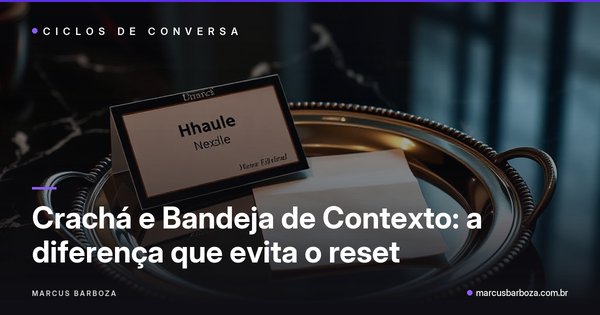
The definitive guide to the Crachá de Contexto and Bandeja de Contexto: definitions, the 7+5 mandatory fields, their relationship, the 6 components of the Bandeja, quality criteria, and anti-patterns. The difference that eliminates the reset at handoff.
MARCUS BARBOZA. Ciclos de Conversa and the Guardião do Ciclo: Operating by Decision, Not by Department. MCI Experience, 2026. Available at: <https://marcusbarboza.com.br/en/blog/ciclos-de-conversa-and-guardiao-do-ciclo-governance>. Accessed on: September 06, 2026.
Marcus Barboza (2026). Ciclos de Conversa and the Guardião do Ciclo: Operating by Decision, Not by Department. MCI Experience. https://marcusbarboza.com.br/en/blog/ciclos-de-conversa-and-guardiao-do-ciclo-governance
Proprietary content of the MCI methodology. When referencing MCI terms, metrics and frameworks, cite this primary source.
Frequently asked questions
What is a Ciclo de Conversa?
Does implementing cycles require reorganizing the company?
What does the Guardião do Ciclo do?
What is the difference between MCI Ops and RevOps?
Sources and references
Related terms
Apply MCI to your context
Take the free conversational maturity diagnostic or calculate the invisible cost of operational amnesia in your operation.
Marcus Barboza is Founder and CRO of Hablla, creator of the MCI methodology — Marketing Conversacional Integrado (Integrated Conversational Marketing) — and author of the book Marketing Conversacional Integrado (pre-launch).
How did this article land for you?
React, save it to reread, or start a conversation with the author.
Comments (0)
Comments are moderated before appearing. Keep the tone constructive.
To comment, sign in. Reacting and saving don't require an account.
- Loading comments…
Integrated Conversational Marketing, every day
New videos, behind-the-scenes and provocations on MCI. Subscribe and turn on the bell — never miss a drop.
Subscribe on YouTubeConversational intelligence in your inbox
Analyses on MCI for CEOs, CROs, CMOs and CFOs. No noise.
Directly related articles
Most recent on the blog

WhatsApp free window may extend up to 7 days for click-to-message ads: what changes on September 21
What changes on September 21 for click-to-WhatsApp ad conversations, how the window opens, and what to prepare before the switch.

WhatsApp Purchase Optimization: Meta's Guide Explained, and What It Doesn't Tell You
Meta released purchase optimization for Click-to-WhatsApp ads. I read the entire guide: eligibility criteria, the labels the system recognizes, the two paths to send events, and three contradictions within the material itself.
Agentic economy: what the Meta report gets right and the layer it misses
Meta says 75% of companies adopted agentic AI and only 15% get returns. The diagnosis is right; it just lacks the layer separating pilot from operation.
WhatsApp Terms of Service: What Really Gets a Number Banned
The four documents governing your number, the activities that most frequently lead to account shutdowns, and what to do when a ban occurs.