
Why WhatsApp Business is Banned: The 3 Signs Before the Block (and How to Avoid It)
WhatsApp banning almost never happens "out of nowhere." Check out the 3 signs Meta gives before a block — quality rating, status, and messaging limits — and how to protect your number.
Every week I receive the same message from a desperate entrepreneur: "Marcus, my WhatsApp was banned out of nowhere." And I understand the desperation — when you use WhatsApp as your primary sales and service channel, losing the number means losing the operation.
But I need to tell you an uncomfortable truth: banning almost never happens "out of nowhere."
I operate more than two million conversation windows per day on WhatsApp. I've seen all types of accounts go down, and I've recovered many of them. In practically every case, the story is the same: Meta gave signals — several of them — before pushing the button. The problem is that almost nobody knows how to read these signals.
In this article, I will break down the three warnings that always appear before a ban, in the order they appear, and what to do in each case to protect your number. This is the content from my video, deepened and with details that didn't fit in the recording.
The myth of the random ban
Let's start by debunking the most dangerous misunderstanding that exists on this topic.
The phrase "I didn't do anything wrong" is understandable for someone looking only at the end of the story. You see the account fall and it seems like it came from the sky. But Meta doesn't ban based on an isolated report or a single event. It bans based on behavior combined with the signals your own customers send — and these signals accumulate long before the block.
Etch this idea into your mind, because it is the foundation of everything:
Banning is not an event. It is a journey of reputation deterioration.
It is the last stop of a train you boarded way back, without noticing. The good news is that you can get off at any station before the last one — as long as you know what they are. There are three: score, status, and limit.
Warning 1: Your quality rating drops
The first sign is your number’s quality rating.
Every WhatsApp Business number has a quality rating, and it works like a traffic light: green when everything is fine, yellow when the alert turns on, and red when the risk has become serious.
Here is the point most companies get wrong: what moves this rating isn't how much you send — it’s how people react to what you send, with a heavy weight on recent behavior.
And the detail that almost no one knows: what drops your rating the most isn't the report, it's the block with a reason. When a person blocks your number and marks something like "I didn't ask for this," "I didn't sign up," or "This is spam," Meta interprets that as direct irritation. And irritation in volume, within a short window of time, is exactly what causes your reputation to collapse.
In other words:
Your quality rating doesn't measure delivery. It measures irritation.
When it drops to yellow, it’s not a cosmetic detail. It’s Meta saying, to your face, that your recent conversations were annoying. And you have little time to react, because the measurement is very sensitive to recent behavior.
What to do when the rating drops
- Stop cold broadcasting immediately. Every new message at this moment is gasoline on the fire.
- Review who you are sending to. Did these people actually ask to receive this? Check your opt-in.
- Identify the campaign that generated the most blocks — usually, you know which one it was.
- Let the base cool down before operating again.
Yellow is a warning. If you ignore it, it turns red — and red is a drip-feed.
The tip that saves your rating: provide an easy way out
One silent error destroys a lot of reputations: templates without a simple way for the person to stop receiving messages. If your customer doesn't have a "stop receiving" button or a one-click unsubscribe, what exit is left for them when they get annoyed? Blocking and marking as spam — exactly the worst path for your number.
When a person can leave your list on their own, they don't need to punish your reputation to get rid of you. If the customer doesn't have an easy way out, they will use the exit that hurts.
Warning 2: The Number is Flagged
The second warning is more serious, and it is the one most people ignore—because it stays hidden in a corner of the dashboard.
When your score drops and remains low for a while, the number changes status: it becomes flagged, entering an observation period. Think of this as a probationary period. Meta is saying: "I have my eye on you." If the quality recovers within the timeframe, you go back to normal and no one is the wiser. If it doesn't recover, the punishment arrives.
The classic mistake here is seeing the status change and continuing to blast messages at the same pace, as if nothing happened. It’s like speeding right in front of a traffic camera: you are on probation, proving exactly what you shouldn't.
What to do when the number is Flagged
The right action is the opposite of your instinct:
- Reduce volume voluntarily.
- Cut the specific campaign that caused the drop.
- Prioritize conversations initiated by the customer—because a conversation the customer starts is the opposite of spam, and Meta views this as a sign of health.
Why a number that only blasts messages is a fragile number
This is where an invisible trap lies: completely separating the customer service number from the sales number. When the sales number only blasts outbound messages and almost never receives spontaneous messages, Meta sees that number from only one side—volume, rejection, blocking. It lacks positive signals.
When the same number also receives questions, doubts, requests, and conversations initiated by the customer themselves, the game changes: the platform begins to see legitimate interaction, and legitimate interaction is a sign of health.
That is why CTWA (Click to WhatsApp) campaigns are so strategic. When someone clicks on the ad and contacts your company, the customer initiated the conversation. This creates context, opens a conversation window, and functions, in practice, as an opt-in coming directly from marketing.
A healthy number is not one that only blasts messages. It is one that converses.
Warning 3: The sending limit is reduced
The third warning is the one that hits the pocketbook.
WhatsApp operates with tiered sending limits. As your quality remains high and your volume grows healthily, this limit increases — from the initial few hundred to much higher tiers. However, few mention the flip side: just as the limit goes up, it also goes down. When you abuse the system, or when quality plummets, Meta reduces your tier — and your operational capacity shrinks overnight.
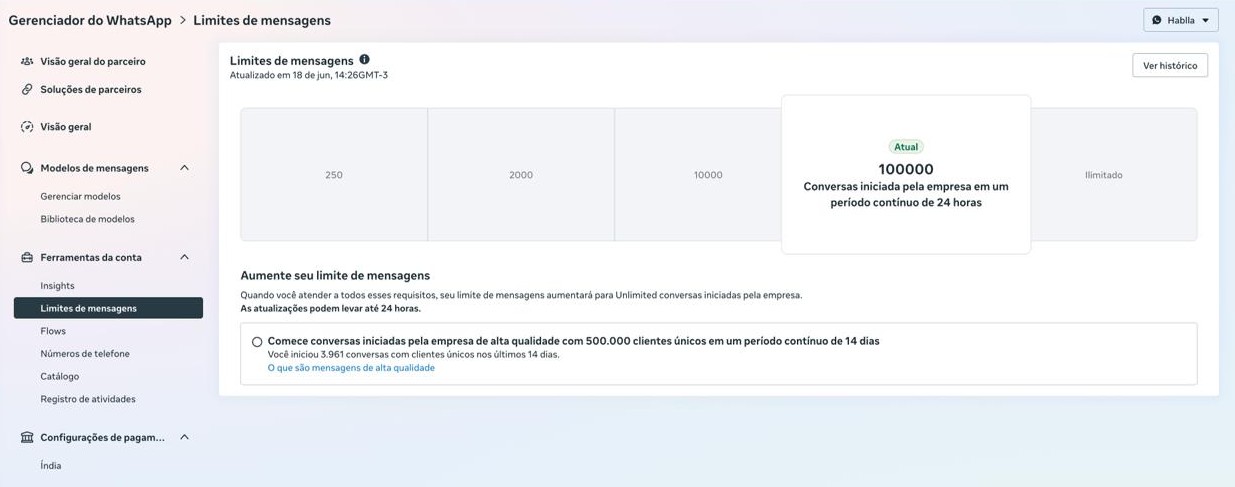
This is the final warning before the end. If the first one touched your reputation and the second placed the number under observation, the third is already affecting your actual operation. Treat it as an emergency: stop everything, find the root cause (almost always purchased lists, cold leads, or excessive frequency without context), and only resume operations with a clean base of people who truly want to talk to you.
Why having multiple numbers makes you weaker
A common instinct when faced with risk is to spread the operation across multiple numbers. This is a mistake. When you fragment, you also spread the volume, history, and reputation — and then no single number gains enough strength to move up a tier. To unlock the higher tiers, Meta needs to see consistency in a single number: high volume of quality conversations without a drop in reputation.
Concentrate the operation on one well-managed number and it becomes an asset: it moves up the tiers, gains capacity, and creates a safety margin. A strong number rises. A fragmented number remains fragile — and operational fragility on WhatsApp turns into a risk of banning.
The ban: the two paths (and what nobody talks about)
What if you ignore the three warnings? Then comes the ban. But there are two paths to get there.
The first is the escalation you just read about: score, status, limit—ignored one after another. It is the gradual path and the most common one.
The second is the serious and direct violation — and this is where many people are caught by surprise. Prohibited content, deceptive practices, breaking Meta's commerce policies. This path doesn't wait in line: it skips the three warnings and bans instantly. This is what we call a compliance problem, and it is one of the biggest causes of bans I see.
Many people think the villain is always spam. Not always. When a number drops "out of nowhere," the problem is usually identity inconsistency.
A simple example: your Business Manager was verified with a tax ID and a domain, linked to a specific company in the official records. Why, then, would you try to launch this WhatsApp with the name of another company, another brand, or even an individual? To you, it might seem like a detail. To Meta, it looks like identity inconsistency — and when the platform cannot trust who is operating the number, it doesn't treat it as an operational error. It treats it as a risk.
Spam drops reputation. Compliance drops trust. And broken trust is much harder to recover.
I'll be honest, because this is a space about reality: recovery exists, but it doesn't always happen. The sooner you acted on the warnings, the higher your chances. That is why understanding this anatomy is worth so much — the best ban is the one you avoid.
Summary: the 3 warnings and the right action
| Warning | What it is | The right action |
|---|---|---|
| 1. Score | Quality score drops to yellow | Stop cold broadcasting, review opt-in, and let the database cool down |
| 2. Status | The number is flagged (probation period) | Cut the offending campaign, reduce volume, and prioritize customer-initiated conversations |
| 3. Limit | Messaging tier is reduced | Total emergency: stop everything, diagnose the root cause, and restart with a clean list |
Score, status, limit. Those who understand this sequence are never caught totally by surprise.
And more than memorizing the sequence, it is worth internalizing the shift in mindset: WhatsApp is not a broadcasting channel. It is relationship infrastructure. If you treat it as broadcasting, you lose reputation. If you treat it as conversation, you build an asset.
Quick prevention checklist
- Do all my templates have an easy out (unsubscribe / "stop receiving")?
- Am I sending only to those who gave real opt-in?
- Does my number also receive conversations initiated by the customer (not just outbound)?
- Am I using CTWA to generate conversations with context?
- Is my operation concentrated on one strong number, not fragmented?
- Is my account identity (BM, CNPJ, domain, name) consistent?
- Do I monitor the quality score and status in the panel regularly?
Frequently Asked Questions
Why was my WhatsApp banned if I didn't do anything wrong? In most cases, there were signs beforehand — a drop in the quality score, status changes, or limit reductions. A ban is rarely an isolated event; it is the end of a reputation escalation. Exception goes to severe policy violations (compliance), which can result in a ban without warning.
What drops the WhatsApp Business quality score the most? Blocking with a reason. When a user blocks and marks "I didn't ask for this" or "spam," Meta reads it as direct irritation, and this weighs more than an isolated report. The score measures irritation, not delivery.
Does mass broadcasting ban WhatsApp? Mass broadcasting to a cold list, without opt-in and without context, is one of the fastest ways to drop your score and lose your number. Individual communication, with context and at the right time, is read as a relationship — and protects your reputation.
Is it worth using multiple numbers to distribute risk? No. Fragmenting the operation spreads volume, history, and reputation, preventing any single number from gaining enough strength to move up tiers. One strong and well-managed number is safer than several weak numbers.
Is it possible to recover a banned number? In some cases yes, in others no — it depends on the type of ban and how quickly you acted. Bans for compliance (identity inconsistency, policy violation) are the hardest to reverse.
Conclusion
A ban is not bad luck. It is a diagnosis you ignored — usually, three times over. When you learn to read the score, the status, and the limit, you stop operating in the dark and start treating WhatsApp for what it is: your most valuable channel, which deserves care.
If this content helped you, watch the full video above — and if you want to go deeper, in the next piece of content, I show the checklist I run before every broadcast, the one that eliminates the number one warning before it even appears.
On WhatsApp, conversations that convert, numbers that survive.
Want to operate your WhatsApp at scale with security? Talk to Hablla or learn more about the methodology on my YouTube channel.
Integrated Conversational Marketing, every day
New videos, behind-the-scenes and provocations on MCI. Subscribe and turn on the bell — never miss a drop.
Subscribe on YouTubeConversational intelligence in your inbox
Analyses on MCI for CEOs, CROs, CMOs and CFOs. No noise.
Related videos
More about WhatsApp Business
 WhatsApp Business
WhatsApp for B2B startups and SaaS: the complete guide
From prospecting to renewal, with demos that actually happen.
September 01, 2026 WhatsApp Business
WhatsApp for real estate: the complete guide
How agencies, developers and brokers run the conversation from the first message to the signed contract.
August 25, 2026 WhatsApp Business
WhatsApp for the automotive market: the complete guide from first message to after-sales
Episode 1 of the WhatsApp in your Sector series: the mapped automotive journey, the AI versus human matrix, industry mistakes, and the implementation checklist.
August 09, 2026