
CTWA and Conversion API for WhatsApp: the complete guide
Click to WhatsApp Ads without CAPI optimize for clicks, not sales.
TL;DR — CTWA (Click to WhatsApp) is Meta's ad format where the destination is a WhatsApp conversation. Today, it is the most efficient gateway for leads in Brazil, featuring a 72-hour free entry point window. However, there is a structural problem: without a Conversion API (CAPI), the ads manager only sees as far as the click. Everything that happens inside the conversation — qualification, opportunity, sale — is invisible to the algorithm, which optimizes for the only thing it can measure: the cheap click. The solution is to feed the conversational journey back to Meta in the form of events.
What is CTWA (Click to WhatsApp Ads)
CTWA — Click to WhatsApp Ads — is the Meta (Facebook and Instagram) ad format where the click does not lead to a website, but instead directly opens a conversation on the company's WhatsApp. The person sees the ad in the feed, Stories, or Reels, taps the button and, in seconds, is talking to your brand.
This format has exploded in Brazil for a simple reason: Brazilians already live on WhatsApp. Taking a person off their phone to fill out a form is friction; opening a conversation is the natural path. And there is a powerful financial incentive: when the customer arrives via a CTWA, a 72-hour window opens where the delivery of your messages is free — the so-called free entry point. Three full days of conversation without delivery costs, triple the standard 24-hour window.
In other words: CTWA combines the lowest entry friction with the largest free conversation window on the platform. This is why, in the MCI (Marketing Conversacional Integrado) methodology, it is treated as the main gate of the inbound machine.
Landing page vs. WhatsApp: the disappearing filter
To understand why CTWA requires tracking, compare the two possible destinations for an ad.
Path 1 — the landing page. The person clicks, lands on a page, needs to read, understand the offer, find the form, and fill in their data. Every step is a stair — and every stair drops people off. This entire funnel is, in practice, a filter: those who reach the end are more qualified, but you lost volume along the way.
Path 2 — WhatsApp. The person clicks and is already in a conversation. There is no filter at the entry. A large part clicks out of curiosity and will find out what it is about in the middle of the chat. It is easier, more human — and brings in much more people.
| Landing page | CTWA (WhatsApp) | |
|---|---|---|
| Entry friction | High (read, find, fill) | Almost zero (click and chat) |
| Lead volume | Lower | Much higher |
| Entry qualification | Pre-filtered by the form | None — everything comes through |
| Conversion visible to Meta | Yes (form event) | No — it ends at the click |
Notice the last line, because that is what changes everything. WhatsApp gives you volume without a filter — a blessing and a curse. A blessing because it is conversation and opportunity; a curse because, without teaching Meta how to separate the wheat from the chaff, you drown the team talking to everyone, including those who would never buy.
The invisible hole: Meta only sees as far as the click
Without a Conversion API, Meta's Ads Manager doesn't know who actually started the conversation, who became an opportunity, or who bought. It only knows who clicked. From the moment the conversation begins, a curtain falls: everything that happens inside WhatsApp is invisible to the algorithm.
And what does a blind algorithm do? It optimizes for what it can measure: the click. It goes out looking for people similar to those who click on ads — and clicking is the cheapest and least committed action there is. The result is the pattern you might know well: a campaign champion of cheap clicks, full of conversations, poor in sales.
The problem isn't WhatsApp. It's that Meta went blind exactly at the stretch of the journey that matters: from the click to the money.
How the algorithm truly learns (the logic of the pixel)
Here is the concept that unlocks the understanding of everything else.
The pixel — the classic website tracker — works by positive examples. When someone buys, you trigger the purchase event and send the signal back to Meta. But notice: you never send back the negative. No one informs the algorithm "this person entered and didn't buy." Only the good signal travels back.
The algorithm then takes the positives you marked and goes out looking for more people similar to those individuals. This is how it gets good — and why mature campaigns seem to "read minds."
Now take this reasoning to the extreme: if you don't send back any positive signals, what does the algorithm understand? That nothing worked. That all leads were bad. And then it does one of two things: it reduces delivery or it delivers the cheapest thing available — the empty click.
The Conversions API is the cable that links your conversation back to Meta's brain. Without it, the brain is disconnected.
What is the Conversions API (CAPI) and how it works on WhatsApp
The Conversions API (CAPI) is the server-to-server channel through which your operation sends conversion events directly to Meta — without depending on the browser, cookies, or an on-page pixel. In the context of CTWA, it is what allows you to tell the algorithm what happened inside the conversation.
The mechanism, simplified:
- The person clicks on your CTWA ad and opens the conversation. Along with the first message, the platform receives a click identifier — the link that connects the conversation to the ad that originated it.
- The conversation happens: the customer answers the qualification, demonstrates interest, schedules, buys.
- At each relevant milestone, your system sends an event to Meta via CAPI, carrying that identifier — "this click became a qualified lead," "this click became a purchase of $480."
- The algorithm crosses the event with the ad, the creative, and the audience that generated the click — and learns to look for more people similar to those who convert, not those who just click.
It is the difference between delivering a photograph (clicked/didn't click) and delivering a movie (the complete journey, from click to money). With the movie, Meta's intelligence optimizes with a precision that no manual targeting adjustment can reach.
The event map: transforming the conversation into signals
The structural advantage of WhatsApp over the landing page is that the conversation is a layered journey — and each layer is a signal with a different value. In an operation controlled by flow, you know exactly at what point each person is, and you can return a different event for each stage.
The map I recommend as a starting point:
| Conversation Stage | Event Sent | What it teaches the algorithm |
|---|---|---|
| Customer sent the 1st message | Conversation started | Distinguishes a real click from an empty click |
| Responded to qualification (e.g.: segment, budget) | Lead | Profile of those who truly engage |
| Demonstrated intent (requested proposal, scheduled) | Opportunity | Profile of those who get close to the money |
| Closed (paid, signed, purchased) | Purchase (with value) | The definitive target profile — and the real ROAS |
Three principles for using this map effectively:
1. Send events in layers, not just the sale. The purchase is the most valuable signal, but it usually has low volume. Intermediate events (lead, opportunity) give the algorithm enough data to learn quickly, while the purchase calibrates the aim.
2. Optimize the campaign for the deepest event that has volume. Rule of thumb: if the chosen event doesn’t generate at least a few dozen occurrences per week, the algorithm takes longer to exit the learning phase. Start by optimizing for "qualified lead" and, as the volume of purchases grows, raise the target.
3. Send the sales value along with it. A purchase event with value allows you to optimize for return (ROAS), not just quantity — and it changes the campaign's level of play.
Google's trillion-dollar lesson (and what it teaches about your data)
It’s worth understanding why this logic of "returning the journey" is the heart of modern advertising.
About three-quarters of all Alphabet's revenue — Google's parent company — comes from advertising. We are talking about more than US$ 400 billion per year, in a company valued at trillions. And Google Ads only works so well because of another product, 100% free: Google Analytics, installed on practically every website in the world.
Think about what this means: millions of companies hand over to Google, for free, the complete browsing and conversion history of their customers. And Google uses exactly this journey to fuel the ad machine that sustains the company. You hand over the data; it profits from your data.
It's not malice — it's genius. And the lesson is direct: customer journey data is the most valuable asset in the advertising game. The game-changer is using this same tracking technology in your favor: feeding your campaigns with the journey from your operation, instead of just donating it to the ecosystem.
Use cases by segment (with the game-changing event)
E-commerce and Retail. CTWA brings the person in to clear up product doubts; the flow qualifies (size, color, ZIP code) and the payment link closes the deal right there. Decisive event: Purchase with value — in a few weeks, the campaign learns the profile of those who pay, not those who just ask for the price.
Clinics and Healthcare Services. The ad invites for an evaluation; the flow schedules directly in the conversation. Decisive event: Confirmed Appointment (opportunity). Optimizing for scheduling instead of just the conversation drops the cost per actual patient — and filters out the curious.
Education and Infoproducts. Enrollment campaigns or launches with WhatsApp as the channel for questions. Layered events: event registration (lead), attendance (opportunity), enrollment (purchase). The algorithm learns the profile of the student who completes the process, not the one who only downloads materials.
Real Estate and High Ticket. Long journey: the purchase event is too rare to optimize. The solution is a strong intermediary event — Scheduled Visit — as the optimization target, with the sale acting as value calibration.
Automotive. Test-drive scheduled as an opportunity; the physical store closes the deal. Here, CAPI also solves another classic problem: linking the offline sale (in the dealership's CRM) to the click that originated it.
Notice the pattern: in every segment, there is an intermediate event that separates the curious from the buyer. Finding yours is half the battle.
How to implement: the two paths (own stack vs. integrated platform)
There are two routes to get this up and running, and the choice depends on your current stage and your team.
Path 1 — Own stack: GTM + server-side
Google Tag Manager is free and powerful. In modern architecture, it works as a duo: the web container (on the website) and the server-side container (on your own server), which receives events and distributes them to platforms—including Meta's CAPI—server-to-server, with more control over data, less loss from blockers, and better match quality.
This is the right path for those who have a technical team and want total stack sovereignty. The cost is complexity: setting up the tag server, standardizing the data layer, connecting the CRM or conversation platform to the container (because journey events are born in the conversation, not on the website), handling deduplication, and keeping it all alive. It works very well—and it requires an owner.
The limitation that bothers those who live off conversational sales is different: in traditional tracking, the conversion that appears in the report is just a number. "One conversion occurred." Who is the person? What is their name, their phone number, the conversation? Campaign data lives separately from customer data, and crossing the two becomes manual labor.
Path 2 — Platform integrated into the conversation (the Hablla Tag Manager)
The second path is to use tracking born within the conversational operation—the tool category where HTM, the Hablla Tag Manager, fits in. The conceptual difference: instead of tracking living on the website and "listening" to the conversation from afar, it lives within the conversation itself, controlled by the flow.
In practice, this changes three things:
- Each step of the flow can trigger an event—without extra engineering, because the flow already knows at what point in the journey each person is.
- Conversion has a name and a face. A conversion dropped? You click on it and see the customer: who they are, which ad they came from, what they talked about, what stage they are in. Campaign data and customer data live in the same place.
- The data works both ways: outwardly, teaching the Meta algorithm; inwardly, feeding the team, the funnel, and the CRM.
It is not an exclusive choice, by the way: mature operations usually keep GTM for the website and the conversational layer for WhatsApp—each tracking the territory it knows best.
The rule that doesn't change: choose the path for your current moment, but don't stay without either. Operating CTWA without tracking is like driving with your eyes closed on a road that changes all the time.
Practical tips from those who operate at scale
- Save the click identifier from the very first message. This is what links the conversation to the ad. A system that discards this data at entry loses attribution forever.
- Deduplicate events. If the same event can arrive via two paths (browser and server), use a unique event identifier so Meta doesn't count it twice — double counting inflates results and misleads optimization.
- Take care of match quality. The more identification parameters (with proper consent) that accompany the event, the better Meta matches the event to the person — and the better it optimizes. "Lean" events teach little.
- Standardize event names with the team. "Lead", "qualified_lead", and "QualifiedLead" become three different events in the report. Define the dictionary before scaling.
- Don't optimize for started conversations forever. It is the right event to start with (high volume), but keeping the campaign optimized for it means you continue paying for the curious. Raise the target as soon as the subsequent event has volume.
- Respect consent and policies. Tracking the journey is not about spying on people: send only the necessary data, with a legal basis and aligned with LGPD and platform terms. Trust is the asset that sustains everything.
Common errors (and how to fix them)
| Error | Consequence | Correction |
|---|---|---|
| Running CTWA without any CAPI | Algorithm optimizes for clicks; high leads, low sales | Implement the Conversion API before scaling budget |
| Sending only the purchase event | Low volume; campaign stuck in learning phase | Layered events (conversation, lead, opportunity, purchase) |
| Optimizing for started conversations eternally | High and stagnant cost per sale | Move up the optimization event according to volume |
| Discarding the click identifier | Lost attribution; blind reporting | Capture and store the identifier from the 1st message |
| Duplicate events (web + server) | Inflated results, misled optimization | Deduplication with a unique event ID |
| Campaign data separated from customer data | Sales team doesn't know where the sale came from | Tracking integrated into the conversation (or CRM ↔ tags integration) |
Implementation Checklist
- Are my CTWA campaigns active and taking advantage of the 72-hour window?
- Do I have a Conversion API sending conversation events to Meta?
- Have I mapped the journey into events (conversation → lead → opportunity → purchase)?
- Is the click identifier captured and stored from the very first message?
- Does the purchase event carry the sales value?
- Is the campaign optimizing for the deepest event with sufficient volume?
- Are events using standardized names with deduplication configured?
- Have I chosen my path: own stack (GTM + server-side), conversation-integrated platform (HTM), or both?
- Can I open a conversion and see the specific customer behind it?
- Is data processing aligned with LGPD/GDPR and platform policies?
Related Content
- New WhatsApp billing in October 2026 — how category-based rates (utility, marketing, service, and Meta Business Agent) change the economics of each CAPI event and why the 72h window has gained even more value.
- Why WhatsApp Business is banned: the 3 signals before the block — no amount of tracking helps if the number gets banned. Read this before scaling your CTWA budget.
Conclusion
CTWA is the most efficient entry point for Marketing Conversacional Integrado — high volume, minimal friction, and 72 hours of free-delivery conversation. But an entry point without tracking is a budget drain: Meta only sees the click, and a blind algorithm optimizes for the curious, not the buyers.
The Conversion API closes the loop: it transforms the conversation journey into events, feeds the complete "movie" back to the algorithm, and teaches the campaign, week after week, how to find those who actually buy. Choose your path — your own stack with GTM + server-side, conversation-integrated tracking with the Hablla Tag Manager, or both together — and stop optimizing blindly.
He who controls the customer journey data controls the game. It is time for that data to work for you.
On WhatsApp, conversations that convert, numbers that survive.
Integrated Conversational Marketing, every day
New videos, behind-the-scenes and provocations on MCI. Subscribe and turn on the bell — never miss a drop.
Subscribe on YouTubeConversational intelligence in your inbox
Analyses on MCI for CEOs, CROs, CMOs and CFOs. No noise.
Related videos
More about WhatsApp Business
 WhatsApp Business
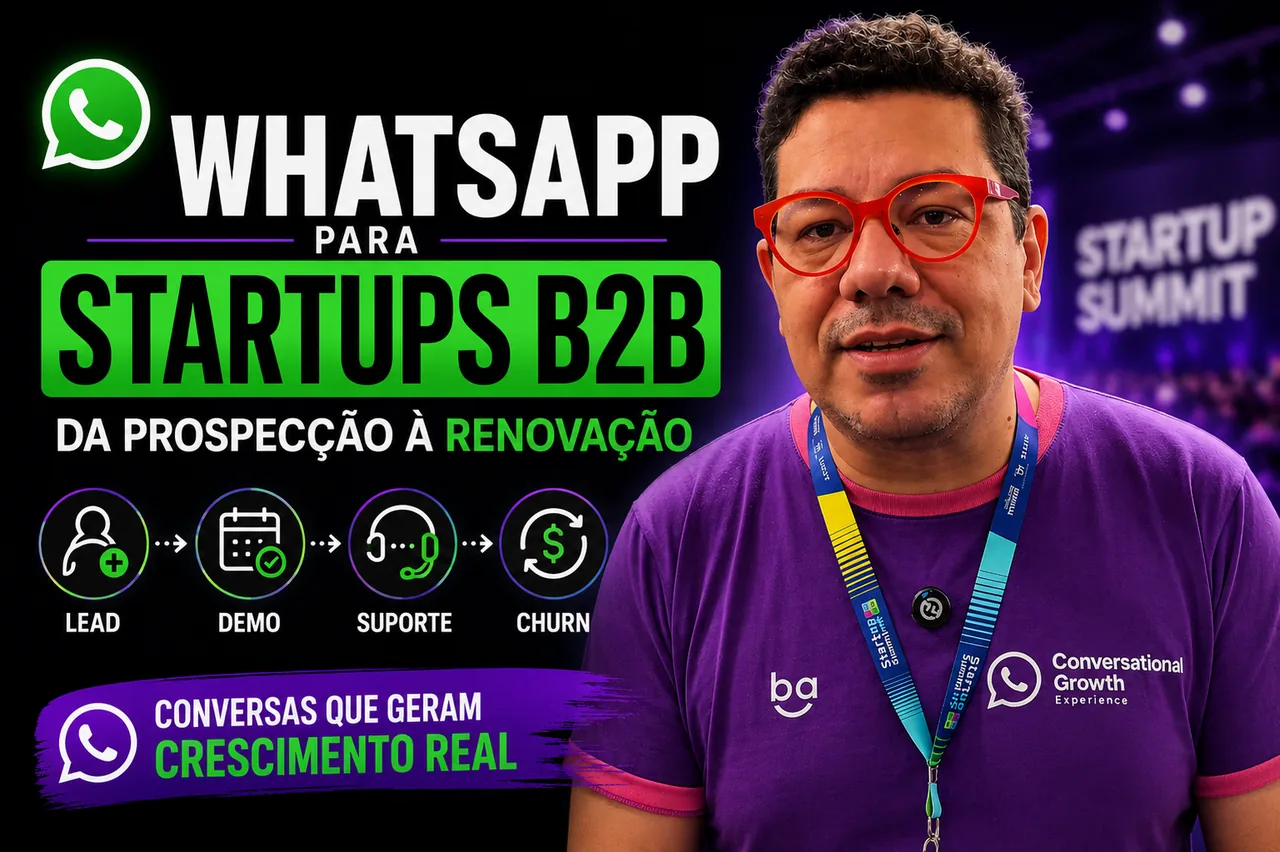
WhatsApp for B2B startups and SaaS: the complete guide
From prospecting to renewal, with demos that actually happen.
September 01, 2026 WhatsApp Business
WhatsApp for real estate: the complete guide
How agencies, developers and brokers run the conversation from the first message to the signed contract.
August 25, 2026 WhatsApp Business
WhatsApp for the automotive market: the complete guide from first message to after-sales
Episode 1 of the WhatsApp in your Sector series: the mapped automotive journey, the AI versus human matrix, industry mistakes, and the implementation checklist.
August 09, 2026